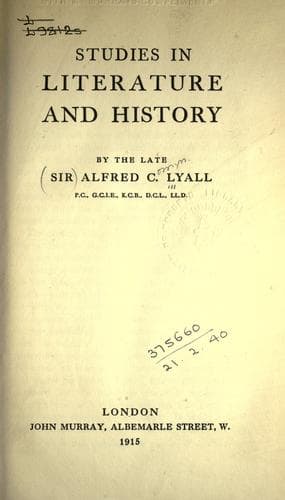
Studies in Literature and HistoryLyall, Alfred C., Sir
Religion
Studies in Literature and History
Lyall, Alfred C., Sir
English literature; History; Literature; Religion; Utilitarianism
The preservation and posthumous publication of private correspondence
has supplied modern society with one of its daintiest literary
luxuries. The art of letter-writing is, of course, no recent
invention; it reached a high level of excellence, like almost every
other branch of refined expression in prose or verse, in the older
world of Rome. Nevertheless, the exceeding rarity of the specimens
that have come down to us from those times is an important element of
their value; while in our own day the letters of eminent persons fill
many book-shelves in every decent library, and their quantity
increases out of all proportion to their quality.
It may be said, generally, of fine letter-writing that it is a
distinctive product of a high civilisation, denoting the existence of
a cultured and leisurely class, implying the conditions of secure
intercourse, confidence, sociability, many common interests, and that
peculiar delight in the stimulating interchange of ideas and feelings
which is one characteristic of modern life. The language of a country
must have thrown off its archaic stiffness, must have acquired
suppleness and variety; the writer's instrument must be a style that
combines familiarity with distinction, correctness of thought with
easy diction. It is from the lack of these conditions that the Asiatic
world has given us no such letters; the material as well as the
intellectual environment has been wanting. For similar reasons the
middle ages of Europe produced us none of the kind with which we are
now dealing; the sixteenth and the seventeenth centuries have left us
very few samples of them; and since in this article we propose to
treat only of English letter-writers, we may affirm that the art did
not flourish in England until the eighteenth century, when according
to certain authorities it rose to something like perfection. It is a
notable observation of Hume's that Swift is the first Englishman who
wrote polite prose; and Swift is one of the earliest, as he is still
one of the pleasantest, writers of private correspondence that has
taken a permanent place in our literature.
Public-domain text, read in full here on John Shaqi.
Reviews
Reviews
No reviews yet
Be the first to share your thoughts on this work.
Join the Discussion
Join the discussion
Sign in to leave a comment or review.
Sign InorCreate an account