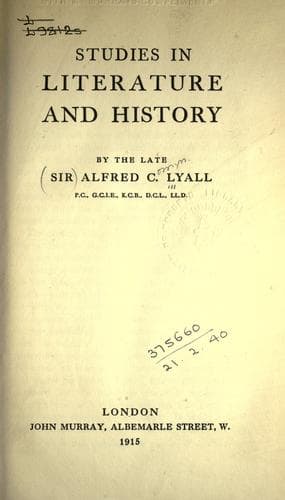
Studies in Literature and HistoryLyall, Alfred C., Sir
Religion
Studies in Literature and History
Lyall, Alfred C., Sir
English literature; History; Literature; Religion; Utilitarianism
Walpole lived just long enough to bring his historical work, which
occupied him for about thirty years, to the end which he had assigned
to it. In traversing such an extensive and varied field of arduous
labour some errors and shortcomings were inevitable, for the history
of England in the nineteenth century is the history of the British
Empire at its climacteric, of moral and material changes and
developments more numerous and perhaps more important than in any
former century. Nor did he limit his survey to the particular period
that he had chosen; for his theory, as he has stated it, of the
function of history, was that it shall not merely catalogue events but
shall go back to an analysis of their causes, and of the general
progress of the human family. He believed, with Lord Acton, that the
recent past contained the key to the present time. It has been said
that Walpole undertook to do for the nineteenth century what Lecky did
for the eighteenth century: and we may agree that both historians have
filled up, with distinguished merit and ability, large vacant spaces
in the history of our country. Perhaps Lecky had more of the
philosophic mind, while the distance of time that lay between that
writer and his period enabled him to see men and things in their true
proportion, and to judge of events by their outcome. Walpole, on the
other hand, wrote under the disadvantages as well as the advantages of
close proximity to the scenes which he described; and the conclusion
of his history marks the fall of the curtain on a drama of which the
final acts are still to be played out.
FOOTNOTES:
[54] _Proceedings of the British Academy_, vol. iii.
REMARKS ON THE READING OF HISTORY[55]
Since I have accepted, at the request of your Warden, the honour of
delivering an inaugural address on this occasion, it has appeared to
me appropriate to choose, for such an audience, some literary subject.
And I propose, with some diffidence, to offer a few observations on
the reading of history, because in these latter days, when education
has come in upon us like a flood, rising higher and spreading wider
every year among our people, no part of literature is more sedulously
studied than the field of history. On the other hand, this field is
being very rapidly enlarged. It has been said that the output of
histories during the nineteenth century has exceeded in bulk and
volume the production of all previous centuries. And in all the
countries now standing in the forefront of civilisation, the chief
product of their serious literature is at this time historical and
biographical--for I take authentic biography to be a kind of handmaid
of history. It has been reported that during the ten years ending 1907
there were published in England 5498 books under the head of history,
and 1059 biographies. Moreover, of those who are not actually writing
history, an important number are occupied in criticising the
historians.
Public-domain text, read in full here on John Shaqi.
Reviews
Reviews
No reviews yet
Be the first to share your thoughts on this work.
Elsewhere in the archive
Join the Discussion
Join the discussion
Sign in to leave a comment or review.
Sign InorCreate an account