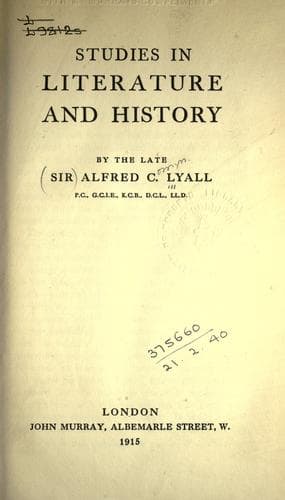
Studies in Literature and HistoryLyall, Alfred C., Sir
Religion
Studies in Literature and History
Lyall, Alfred C., Sir
English literature; History; Literature; Religion; Utilitarianism
Now the first observation that I submit to you is that the production
of all history has been almost entirely the work of Europeans, among
whom I reckon the American writers, as belonging by language and
culture to Europe. So far as the African continent has any trustworthy
history, it is in some European language. In Asia there have been
annalists, chroniclers, and genealogists, mostly Mohammedan, who
narrate the wars and exploits of great conquerors, the succession of
kings, and the rise and fall of dynasties. And I believe that in China
official record of public events and transactions has been kept up
from very early ages. But if we measure these Asiatic narratives by
the standard of literary merit and the demand for authentication of
facts, I fear that they will be found wanting; though they may be
relied upon to give the general course of important events, and an
outline of the result of battles and the upsetting of thrones.
When these Asiatic chroniclers wrote of the times in and near which
they were living, they were fairly trustworthy. But whenever they
attempted to write of times long past and of countries unknown to them
personally, their narratives became for the most part fabulous and
romantic, confused and improbable, with some grains of truth here and
there. Our best information regarding the earlier ages of Asia is
derived, I think, from Greek and Latin literature, and latterly from
the researches of quite modern scholars and archaeologists. So that it
may be affirmed that authentic history began in Europe, and that to
Europe it has ever since been practically confined. At this day the
history of all parts of the world is being written by Europeans. The
result has been that for the last 2500 years historical material,
collected from and relating to all parts of the world, has been
accumulating in Europe.
Such masses of records and monuments necessarily require methodical
treatment by men of trained intelligence and of untiring industry,
learned, and accurate. Their systematic labours, their acute and
intelligent criticism, have created what is now usually termed the
Science of History, which abstracts general conclusions from the mass
of particulars. And so, I think, we may agree with Renan, who has
declared that to the nineteenth century may be accorded the title of
the Age of Historians, and that this has been the special distinction
of that century's literature.
Public-domain text, read in full here on John Shaqi.
Reviews
Reviews
No reviews yet
Be the first to share your thoughts on this work.
Elsewhere in the archive
Join the Discussion
Join the discussion
Sign in to leave a comment or review.
Sign InorCreate an account