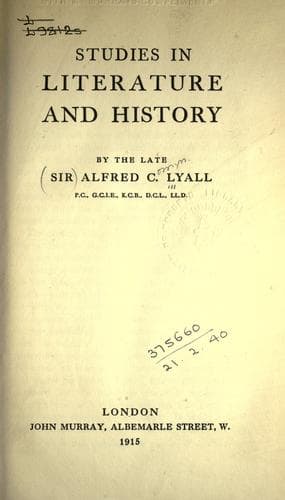
Studies in Literature and HistoryLyall, Alfred C., Sir
Religion
Studies in Literature and History
Lyall, Alfred C., Sir
English literature; History; Literature; Religion; Utilitarianism
Now I believe that the question, whether history is an art or a
science, is not yet universally settled. But whatever may be the case
in these modern days, I submit that in earlier times, and certainly
when history began to be written, it was mainly an art. Indeed, it
could hardly have been otherwise. In all ages and countries, from the
time when men first attained to some stage of elementary culture, they
have been curious about the past, they have enjoyed hearing of the
deeds and fame of their ancestors, of far-off things and battles long
ago. But the primitive chronicler had very slight material for his
stories of bygone times--he had few, if any, documents--he was himself
creating the documentary evidence for those who came after him; he
could only compile his narratives from tradition, legends, anecdotes
of heroic ancestors, from information picked up by travel to famous
places, and so on. Yet from sources of this kind he composed tales of
inestimable value as representing the ideas, habits, and social
condition of preceding generations that were very like his own.
Herodotus, who is our best example of the class, reconstructs,
revives, and relates conversations that neither he nor his informants
could have actually heard; but he does this in order to give a
dramatic version of great events. In the opening sentence of his first
book he says that he has written in order that the actions of men may
not be effaced by time, nor great and wondrous deeds be deprived of
renown. And one may notice the same style and method in the
historical books of the Old Testament. In both these ancient histories
the narratives represent life, action, speech, situations.
It is futile, I may suggest, to subject work of this sort to critical
analysis by attempting to sift out what is probably true from what is
certainly false. You only break up the picture, you destroy the
artistic effect, which is at least a true reflection of real life.
Moreover, it is dangerous for learned men sitting in libraries to
regard as incredible facts stated by these old writers. The legend of
Romulus and Remus having been suckled by a wolf has been dismissed as
a childish fable. Yet it is certain that this very thing has happened
more than once in the forests of India within the memory of living
men. You cannot be particular about details, you must take the story
as a whole.
Public-domain text, read in full here on John Shaqi.
Reviews
Reviews
No reviews yet
Be the first to share your thoughts on this work.
Elsewhere in the archive
Join the Discussion
Join the discussion
Sign in to leave a comment or review.
Sign InorCreate an account