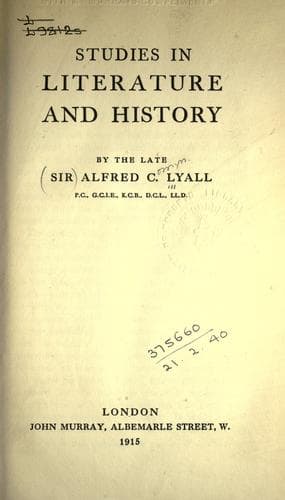
Studies in Literature and HistoryLyall, Alfred C., Sir
Religion
Studies in Literature and History
Lyall, Alfred C., Sir
English literature; History; Literature; Religion; Utilitarianism
CHARACTERISTICS OF MR. SWINBURNE'S POETRY 263
FRONTIERS ANCIENT AND MODERN 291
L'EMPIRE LIBERAL 328
SIR SPENCER WALPOLE 368
REMARKS ON THE READING OF HISTORY 377
RACE AND RELIGION 399
THE STATE IN ITS RELATION TO EASTERN AND WESTERN RELIGIONS 427
INDEX 454
NOVELS OF ADVENTURE AND MANNERS[2]
Mr. Raleigh[3] very rightly goes back to mediaeval romance for the
origins of English fiction. In all countries the metrical tale is many
generations older than the prose story; for prose writing is a
refinement of the literary art which flourishes only when reading has
become popular; while verse, being at first a kind of _memoria
technica_ used for the correct transmission of sacred texts and the
heroic tradition, strikes the ear and fixes the recollection of an
audience. The exploits of mighty warriors and the miracles of
saints--love, fighting, and theology--form the subject matter of these
stories in verse. They are, as Mr. Raleigh says, epical in spirit
though not in form: 'they carry their hero through the actions and
adventures of his life ... they display a marked preference for deeds
done, and attempt no character-drawing.... A sense of the instability
of human life, very present to the minds of men familiar with battle
and plague, is everywhere mirrored in these romances.' Then came
Chaucer, who not only wrote prose tales, but also carried far toward
perfection the art of narration in verse; and 'in the fifteenth
century both of the ancestors of the modern novel--that is, the
novella or short pithy story after the manner of the Italians, and
the romance of chivalry--appear in an English prose dress.' But the
genius of English fiction was still loaded with the chains of allegory
and pedantic moralisation; and in the _Gesta Romanorum_, the most
popular collection of English prose stories which had been translated
from the Latin at the end of the fifteenth century, 'human beings are
mere puppets, inhabiting the great fabric of mediaeval thought and
mediaeval institution.... It was the work of the Renaissance to recover
the literal and obvious sense of human life, as it was the work of the
closely-allied Reformation to recover the literal sense of the Bible.'
Public-domain text, read in full here on John Shaqi.
Reviews
Reviews
No reviews yet
Be the first to share your thoughts on this work.
Join the Discussion
Join the discussion
Sign in to leave a comment or review.
Sign InorCreate an account