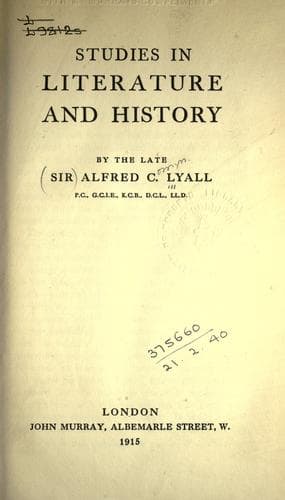
Studies in Literature and HistoryLyall, Alfred C., Sir
Religion
Studies in Literature and History
Lyall, Alfred C., Sir
English literature; History; Literature; Religion; Utilitarianism
with his poetry.
In the case of other poets, who were his contemporaries, the verdict
will be different. They are all to be classed, though not in the same
line, as writers of letters that have great original and intrinsic
value. Scott's letters exhibit his generous and masculine nature; the
buoyancy of his spirits in good or bad fortune; and that romantic
attachment to old things and ideas which hardened latterly into
inveterate Toryism. Southey's prose writings will probably survive his
metrical compositions, which indeed have already fallen into oblivion.
There is life in a poet so long as he is quoted; but no verses or even
lines of Southey have fixed themselves in the popular memory. And
whereas the letters of Keats disclose a mind filled with the sense of
beauty and rich with poetic seedlings that blossomed into beautiful
flowers, in Southey's correspondence we discern only an erudite man of
taste labouring diligently upon epics which he expected to be
immortal. The letters of Byron stand upon broader ground, because
Byron was so much more of a personage than either Keats, or Southey,
or Wordsworth. They supply, in the first place, an invaluable, and
indeed indispensable, interpretation of his poetry, which is to a
great extent the imaginative and romantic presentation of his own
feelings, fortunes, and peculiar experiences. Secondly, they are full
of good sayings and caustic criticism; they touch upon the domain of
politics and society as well as upon literature; they give the
opinions passed upon contemporary events and persons, during a
stirring period of European history, by a man of genius who was also a
man of the world; they float on the current of a strangely troubled
existence. In these letters we have an important contribution to our
acquaintance with literary circles and London society, and with
several notable figures on either stage, during the years immediately
before and after Waterloo. They were published in an introduction to
the works of a famous poet; yet, although they cannot be detached from
his poetry, they possess great independent merits of their own. They
echo the sounds of revelry by night; they strike a note of careless
vivacity, the tone of a man who is at home alike in good and bad
company, whose judgment on books and politics, on writers and
speakers, is always fresh, bold, and original. We may lament that the
spirit of reckless devilry and dissipation should have entered into
Byron; and the lessons to be drawn from the scenes and adventures in
Venice and elsewhere, described for the benefit of Tom Moore, are very
different from the moral examples furnished by the tranquil and
well-ordered correspondence of our own day. Yet the world would have
been poorer for the loss of this memorial of an Unquiet Life, and the
historical gallery of literature would have missed the full-length
portrait of an extraordinary man.
Public-domain text, read in full here on John Shaqi.
Reviews
Reviews
No reviews yet
Be the first to share your thoughts on this work.
Join the Discussion
Join the discussion
Sign in to leave a comment or review.
Sign InorCreate an account