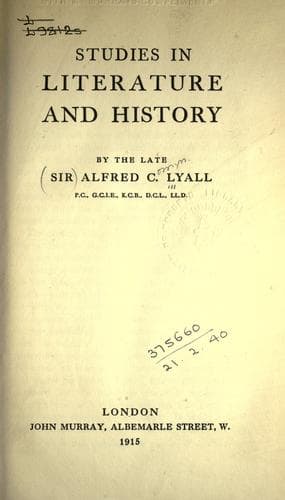
Studies in Literature and HistoryLyall, Alfred C., Sir
Religion
Studies in Literature and History
Lyall, Alfred C., Sir
English literature; History; Literature; Religion; Utilitarianism
It is evidently impossible to draw a line that shall accurately divide
the interest that men feel in a celebrated person from the interest
that they take in his posthumous correspondence; so as to determine
how far the letters are good in themselves. When the writer is well
known, he and his writings are inseparable. Yet some attempt must be
made, for the purposes of this article, to distinguish critically
between letters that are readable and will survive by their own
literary quality, as fine specimens of the art, and those which are
preserved and published on the score of the writer's name and fame,
with little aid from their merits. In which category are we to place
the letters of Keats, including those that have been very recently
unearthed by diligent literary excavation? His poetry is so exquisite,
so radiant with imaginative colour, that to see such a man in the
light of common day, among the ordinary cares and circumstances of the
lower world, is necessarily a descent and a disillusion. He was young,
he was poor, he had few acquaintances worthy of him; he roved about
England and Scotland without adventures; his letters were perfectly
familiar and unsophisticated. As Mr. Sidney Colvin has written, in an
excellent preface to an edition of 1891, 'he poured out to those he
loved his whole self indiscriminately, generosity and fretfulness,
ardour and despondency, boyish petulance side by side with manful good
sense, the tattle of suburban parlours with the speculations of a
spirit unsurpassed for native gift and insight.' Every now and then
the level of his easygoing discourse is lit up by a flash of wit, and
occasionally by a jet of brilliant fancies among which some of his
finest poetry may be traced in the process of incubation. His whole
mind is set upon his art; for that only, and for a few intimate
friends, does he care to live and work; his letters often tell us when
and where, under what influences, his best pieces were composed; one
likes to know, for example, that the _Ode to Autumn_ came to him on a
fine September day during a Sunday's walk over the stubbles near
Winchester. His criticisms are always good, and their form
picturesque. He compares human life to a chamber that becomes
gradually darkened, in which one door after another is set open,
showing only dim passages leading out into darkness. This, he says, is
the burden of the mystery which Wordsworth felt and endeavoured to
explore; and he thinks that Wordsworth is deeper than Milton, though
he attributes this, justly, more to 'the general and gregarious
advance of intellect, than individual greatness of mind.' So far as
spontaneity and the free unguarded play of sportive and serious ideas,
taken as they came uppermost, are tests and conditions of excellence
in this kind of writing, Keats's letters must rank high. Nevertheless
there is still room for doubt whether these juvenile productions would
have left any but a most ephemeral mark apart from their connection
Public-domain text, read in full here on John Shaqi.
Reviews
Reviews
No reviews yet
Be the first to share your thoughts on this work.
Join the Discussion
Join the discussion
Sign in to leave a comment or review.
Sign InorCreate an account