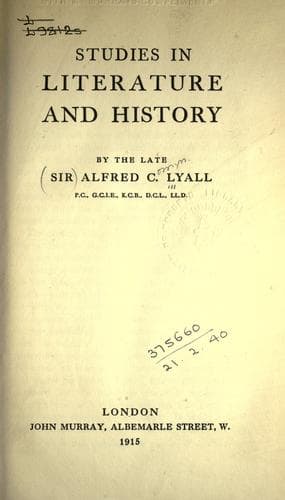
Studies in Literature and HistoryLyall, Alfred C., Sir
Religion
Studies in Literature and History
Lyall, Alfred C., Sir
English literature; History; Literature; Religion; Utilitarianism
William Godwin, pedantic, self-conceited, and impecunious, has come
down to us as a kind of central figure in a literary group which
included such men as Coleridge, Shelley, and Lamb, of whom the
somewhat formal English world at the beginning of this century was not
worthy. By reason of this position, and because Shelley married his
daughter, he became the cause and subject of excellent letter-writing,
though his own correspondence is heavy with philosophic platitudes. It
is of the class which, as we have said, is akin to essays; he
discourses at large upon first principles in religion and politics;
and out of his frigid philosophy came some of Shelley's most ardent
paradoxes. But some of the most amusing letters in the English
language were addressed to him. It was after a supper at Godwin's that
Coleridge wrote remorsefully acknowledging 'a certain tipsiness'--not
that he felt any 'unpleasant titubancy'--whereby he had been seduced
into defending a momentary idea as if it had been an old and firmly
established principle; which (we may add) has been the way of other
talkers since Coleridge. No one, he goes on to say, could have a
greater horror than himself of the principles he thus accidentally
propounded, or a deeper conviction of their irrationality; 'but the
whole thinking of my life will not bear me up against the crowd and
press of my mind, when it is elevated beyond its natural pitch.' The
effect of punch, after wine, was to make a philosopher argue hotly
against his profoundest beliefs; yet it is to Godwin's supper that we
owe this diverting palinodia. And all Englishmen should be grateful to
Godwin for having written the tragedy of _Antonio_; for not only was
it most justly damned, but it also elicited some letters to the
unlucky author that are unmatched in the record of candid criticism.
Mrs. Inchbald writes, briefly:
'I thank you for the play of Antonio, and I most sincerely wish you
joy of having produced a work which will protect you from being
classed with the successful dramatists of the present time, but
which will hand you down to posterity among the honoured few who,
during the past century, have totally failed in writing for the
stage.'
Coleridge goes to work more elaborately:
'In the tragedy I have frequently used certain marks (which he
gives). Of these, the first calls your attention to my suspicions
that your language is false or intolerable English. The second
marks the passages that struck me as _flat_ or mean. The third is a
note of reprobation, levelled at those sentences in which you have
adopted that worst sort of vulgar language, commonplace book
language. The last mark implies bad metre.'
Public-domain text, read in full here on John Shaqi.
Reviews
Reviews
No reviews yet
Be the first to share your thoughts on this work.
Join the Discussion
Join the discussion
Sign in to leave a comment or review.
Sign InorCreate an account