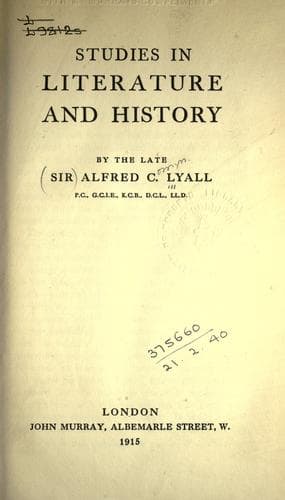
Studies in Literature and HistoryLyall, Alfred C., Sir
Religion
Studies in Literature and History
Lyall, Alfred C., Sir
English literature; History; Literature; Religion; Utilitarianism
All this is free speaking beyond the compass of modern literary
consultations. It may be added that Lamb also discussed the play,
before it was performed, in his letters to Godwin; and that his
description of Godwin's deportment, of his own feelings, and of the
behaviour of the audience on the memorable night that witnessed its
utter failure, has bequeathed to us a comedy over which the tragic
Muse herself might well become hysterical.
There is, indeed, in the correspondence of this remarkable group a
tone of frankness and sincerity which, combined with the absence of
malice and a strong element of fun, distinguishes it from the
half-veiled disapproval and prudish reserve of later days. 'When you
next write so eloquently and well against law and lawyers,' says
Coleridge to Godwin, 'be so good as to leave a larger place for your
wafer, as by neglect of this a part of your last was obliterated.'
Again, in a more serious tone, 'Ere I had yet read or seen your works,
I, at Southey's recommendation, wrote a sonnet in praise of the
author. When I had read them, religious bigotry, the but half
understanding of your principles, and the _not_ half understanding of
my own, combined to render me a warm and boisterous anti-Godwinist.'
His moods and circumstances, his joys and pains, are reflected in his
language with remarkable fertility of metaphor; his feelings vary with
his society. Of Lamb he writes that 'his taste acts so as to appear
like the mechanic simplicity of an instinct--in brief, he is worth a
hundred men of more talents: conversation with the latter tribe is
like the use of leaden bells, one warms by exercise, Lamb every now
and then _irradiates_.' In the best letters of this remarkable group
we perceive the exquisite sensitiveness of open and eager minds,
giving free play to their ideas and feelings, their delight and
disgust, so that their life and thoughts are mirrored in their
correspondence as in their conversation. Such writing has become very
rare, if it is not entirely extinct, in these latter days of temperate
living and guarded writing. Lamb's own letters are all in a similar
key; and that which he wrote to Coleridge, who had a bad habit of
borrowing books, is a model of jocose expostulation: 'You never come
but you take away some folio that is part of my existence.... My third
shelf from the top has two devilish gaps, where you have knocked out
its two eye teeth.' And his lament over the desolation of London, as
it appears to a man who has lived there jovially, and revisits it as a
stranger in after years, may even now touch a chord in the hearts of
some of us.
Public-domain text, read in full here on John Shaqi.
Reviews
Reviews
No reviews yet
Be the first to share your thoughts on this work.
Join the Discussion
Join the discussion
Sign in to leave a comment or review.
Sign InorCreate an account