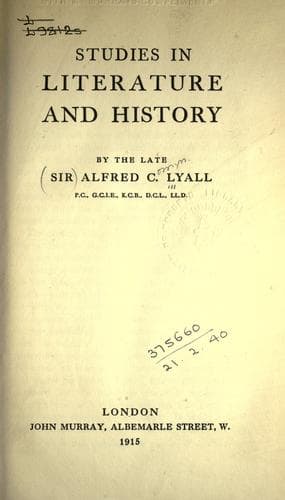
Studies in Literature and HistoryLyall, Alfred C., Sir
Religion
Studies in Literature and History
Lyall, Alfred C., Sir
English literature; History; Literature; Religion; Utilitarianism
In a recent article upon Matthew Arnold's letters it is laid down by a
consummate critic[8] that the first canon of unsophisticated
letter-writing is that a letter is meant for the eye of a friend, and
not for the world. 'Even the lurking thought in anticipation of an
audience destroys the charm; the best letters are always
improvisations; the public breaks the spell.' In this, as we have
already suggested, there is much truth; yet the conditions seem to us
too straitly enjoined; for not every man of genius has the gift of
striking out his best thoughts, in their best form, clear and true
from the hot iron of his mind; and in some of our best writers the
improvising spirit is very faint. If a man writes with leisurely care,
selecting deliberately the word that exactly matches his thought,
aiming directly at the heart of his subject and avoiding prolixity, he
may, like Walpole, Gray, and others, produce a delightful letter,
provided only that he is sincere and open, has good stuff to give, and
does not condescend to varnish his pictures. We want his best
thoughts; we should like to have his best form; we do not always care
so much for negligent undress. And as for the copious outpouring of
his personal feelings, one says many things to a friend or kinsman
that are totally without interest to the public, unless they are
expressed in some distinctive manner or embody some originality of
handling an ordinary event. This a writer may have the knack of doing
artistically, even in a private and confidential letter, without
betraying the touch of art; nor, indeed, can we ever know how many of
the best modern letters are really improvised. Then, again, with
regard to the anticipation of an audience, it is a risk to which
every man of note must feel that he is exposed; the shadow of
eventual publicity is always in the background; his letters have
passed out of his control during his lifetime, and he can only trust
in the uncertain discretion of his literary executor. He does not care
to leave the record of his passing moods, his confessions of weakness,
his personal likings and antipathies, to be discussed by the general
reader; and it is probable that he only lets his pen run freely when
he feels assured that his confidential improvisations will be
judiciously omitted.
Public-domain text, read in full here on John Shaqi.
Reviews
Reviews
No reviews yet
Be the first to share your thoughts on this work.
Join the Discussion
Join the discussion
Sign in to leave a comment or review.
Sign InorCreate an account