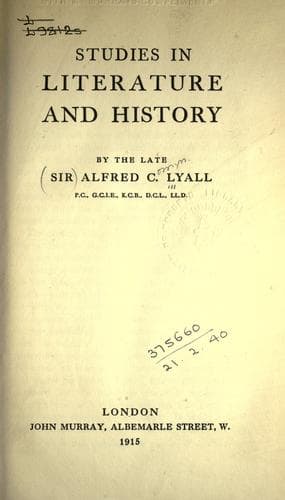
Studies in Literature and HistoryLyall, Alfred C., Sir
Religion
Studies in Literature and History
Lyall, Alfred C., Sir
English literature; History; Literature; Religion; Utilitarianism
On the other hand, his imaginative faculty comes out in his
speculation upon the probable changes in the development of the
American people that might follow their separation into different
groups, if the civil war between the Northern and Southern States
(which had just begun) should break up the Union.
'Climate and mixture of race will then be able fully to tell, and I
cannot help thinking that the more diversity of nation there is on
the American continent, the more chance there is of one nation
developing itself with grandeur and richness. It has been so in
Europe. What should we all be if we had not one another to check us
and to be learned from? Imagine an English Europe. How frightfully
_borne_ and dull! Or a French Europe either, for that matter.'
The suggestion is, perhaps, more fanciful than profound; for history
does not repeat itself; and, in fact, the result of breaking up South
America into a dozen political groups has not yet produced any very
satisfactory development of national character. Much more than
political subdivision goes to the creation of a new Europe;
nevertheless Arnold is probably right in supposing that uniformity of
institutions and a somewhat monotonous level of social conditions over
a vast area, may have depressed and stunted the free and diversified
growth of North American civilisation.
The literary criticism to be found in these letters shows a fastidious
and delicate taste that had been nurtured almost too exclusively upon
the masterpieces of classic antiquity. Homer he ranked far above
Shakespeare, though one might think them too different for comparison;
and he praises 'two articles in _Temple Bar_ (1869), one on Tennyson,
the other on Browning,' which were afterwards republished in a book
that made some stir in its day, and has brought down upon its author
the unquenchable resentment of his brother poets. He thought that both
Macaulay and Carlyle were encouraging the English nation in its
emphatic Philistinism, and thus counteracting his own exertions to
lighten the darkness of earnest but opaque intelligences. As his
interest in religious movements was acute, so his observations
occasionally throw some light upon the exceedingly complicated problem
of ascertaining the general drift of the English mind in regard to
things spiritual. The force which is shaping the future, is it with
the Ritualists or with the undogmatical disciples of a purely moral
creed? With neither, Arnold replies; not with any of the orthodox
religions, nor with the neo-religious developments which are
pretending to supersede them.
Public-domain text, read in full here on John Shaqi.
Reviews
Reviews
No reviews yet
Be the first to share your thoughts on this work.
Join the Discussion
Join the discussion
Sign in to leave a comment or review.
Sign InorCreate an account