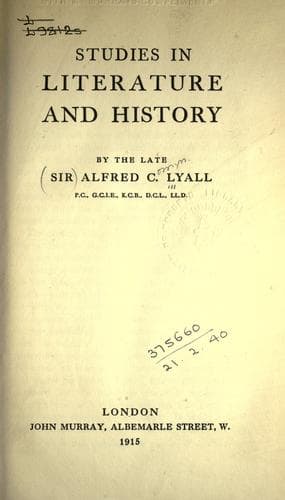
Studies in Literature and HistoryLyall, Alfred C., Sir
Religion
Studies in Literature and History
Lyall, Alfred C., Sir
English literature; History; Literature; Religion; Utilitarianism
dictionaries of antiquities or volumes of travel must damage the
illusion which is the indispensable element of romance. In Moore's
fantastic metrical romance of _Lalla Rookh_ the system was carried to
an extent that now seems ridiculous, for certain passages are loaded
with outlandish phrases or metaphors that are unintelligible except by
reference to the notes. Nevertheless the English public, being then
quite ignorant of the true East, tolerated Moore's sham Orientalism,
even though Byron's fine poems were just then exposing the difference
between working up the subject in a library and wandering in Asiatic
countries. Byron's language seems in the present day turgid, and his
Greeks and Turks may have a theatrical air, but his splendid
descriptive passages were drawn by a master hand straight from nature,
while his colouring, landscape, and costume are usually excellent; so
that his work also is a distinct movement in the direction of realism.
Yet it is to be observed that after Byron and Scott the metrical
romance, that most ancient form of tale-telling, fell rapidly into
disuse. The fact that Byron's latest poem, _Don Juan_, belonged
essentially to the coming realistic school, is a significant
indication of transition; and Scott's abandonment of poetry for prose,
which was a necessary consequence of his advance toward realism, gave
its death-blow to the earlier fashion.
By this time, indeed, the conventional writer of adventures, though he
held his ground up to or even beyond the middle of the century, was in
a state of incurable decadence. He was losing the confidence of the
general reader, who had picked up some precise notions regarding
appropriate scenery, language, and costume in sundry periods and
divers places, from China to Peru; and he was persecuted by that
mortal foe of the old romancer, the well-informed critic, who trampled
even upon a commonplace book well filled with references to standard
authorities, insisting upon careful study of the whole environment,
the dexterous incorporation of details, and delicate blending of local
colours. Severe pedagogic handling of a historic novel, as if it were
a paper done at some competitive examination, was too much for the old
school, which finally subsided into cheap popular editions, making way
for a new class of writers that adapted the Novel of Adventure to the
requirements of latter-day taste, to the widening of knowledge, and
the diversified expansion of our national life. The prevailing
tendency was now to confine the range of scene and action more and
more approximately to the contemporary period, to insist on genuine
materials, and to observe a stricter canon of probabilities, wherein
the discriminating reader fancied himself to be a judge. The use of
notes was discarded as contrary to the high artistic principle that in
fiction everything must resemble reality while nothing must be
demonstrably matter of fact. The appearance of famous personages must
Public-domain text, read in full here on John Shaqi.
Reviews
Reviews
No reviews yet
Be the first to share your thoughts on this work.
Join the Discussion
Join the discussion
Sign in to leave a comment or review.
Sign InorCreate an account