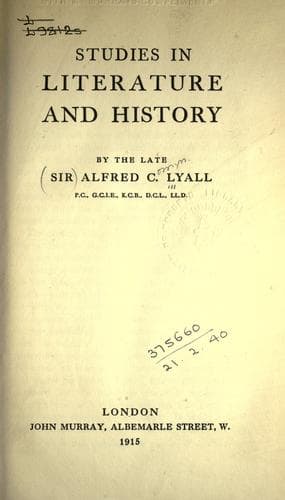
Studies in Literature and HistoryLyall, Alfred C., Sir
Religion
Studies in Literature and History
Lyall, Alfred C., Sir
English literature; History; Literature; Religion; Utilitarianism
be occasional, after the manner of gods in an epic poem; they must not
be, as formerly, the leading characters and chief actors in the drama.
And great battles, instead of marking the grand climacteric of a
story's development, were now merely traversed, so to speak, on their
outskirts, or were only approached near enough to throw a glowing
sidelight on certain groups and situations. The gradual adoption of
these limitations may be traced back to the naval and military novels
that reflect the traditions of the great French war. No one even then
thought of writing a romance with Nelson or Bonaparte as the hero, or
of finishing off in the full blaze of Trafalgar or in the rout of
Waterloo; although with Marryat and Lever the English reader revelled
in the dashing exploits or bacchanalian revels of sailors and
soldiers. Lever did indeed give glimpses of Wellington or Napoleon;
but his business was with Connaught Rangers and French guardsmen;
while Marryat and Michael Scott gave us daring sea-captains and
reckless sailors with inimitable vigour and animation.
But as the echo of thunderous battles by sea and land died away, this
particular offshoot of modern romance ceased to flourish, and has
never had any considerable revival. The tale-teller of adventure, like
his ancestor the epic poet, requires a certain haziness of atmosphere;
he must have elbow room for his inventive faculty; and he is liable to
be stifled in the flood of lucid narrative and inflexible facts let
loose upon recent events in our day by complete histories, personal
memoirs, public documents, war correspondence, and all-pervading
journalism. This is probably the main reason why the Crimean War and
the Indian Mutiny, which broke for brief intervals the long peace of
England, have furnished no fresh material contribution of importance
to the romance of war, either in prose or poetry, to stamp the memory
of a long weary siege, or of a short and bloody struggle, upon the
popular imagination. Another reason must be, of course, the
non-appearance in England of the _vates sacer_; for Tolstoi has shown
us that within and without Sebastopol there might be found material
for work of the highest order. However this may be, it is a remarkable
fact that just about that time the novel of adventure turned back for
a moment, in Kingsley's hands, to the spacious times of great
Elizabeth, to the Armada and the legends of filibustering on the
Spanish main; and at the present time we may observe that the leading
writer of this school goes back at least a hundred years for the field
of his best stories. The eighteenth century, whose politics,
philosophy, and literature seemed to Carlyle's somewhat bookish
conception to be flat, prosaic, and comparatively uninteresting, was
in truth for Englishmen pre-eminently the age of energetic activity,
which touched the high level of romantic enterprise at two points, the
Scottish rebellions and the exploits of famous buccaneers. Mr.
Public-domain text, read in full here on John Shaqi.
Reviews
Reviews
No reviews yet
Be the first to share your thoughts on this work.
Join the Discussion
Join the discussion
Sign in to leave a comment or review.
Sign InorCreate an account