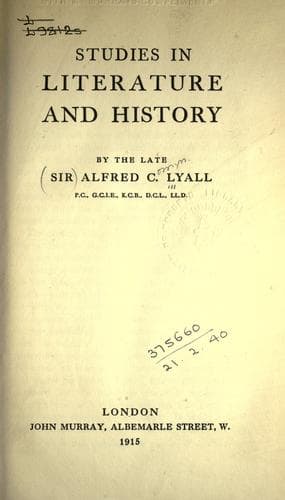
Studies in Literature and HistoryLyall, Alfred C., Sir
Religion
Studies in Literature and History
Lyall, Alfred C., Sir
English literature; History; Literature; Religion; Utilitarianism
Stevenson has reopened, with great skill and success, these mines of
literary ore that had been discovered but only partially worked by
Walter Scott. His rare artistic instinct divined the rich veins which
they still contained; while in other stories his intimate acquaintance
with actual life and circumstance on the coasts and islands of the
Pacific Ocean has provided him with those elements of distance and
unfamiliarity which are essential, as we have suggested, to the
composition of the novel of adventure. Other less original writers
have travelled in search of these elements to the Australian bush or
the outlying half-explored regions of South Africa.
This very cursory survey of the main influences and circumstances that
have shaped the course and set the fashion of our modern novel of
adventure may be useful in explaining its actual position at the
present moment. Scepticism and research have effectually retrenched
the very liberal credit formerly assigned to romance writing; the art
now consists in spinning a long narrative out of authentic materials
which must be disguised or kept hidden; while its leading features are
a delight in elaborate accessories and that very modern sentiment, a
horror of anachronism. A few living artists, like Mr. Shorthouse and
Mr. Stevenson, can still excel under these difficult conditions,
which have driven a crowd of second-rate novelists into the extreme of
minute realism. Into this retreat, however, they have been followed by
a host of readers; for in these days of universal instruction and flat
uneventful existence nothing satisfies the average mind like
photographic detail, which is a commodity to be had of every
industrious or studious composer. As the range of accurate information
extends, as the dust heap of old records, private as well as public,
is sifted more narrowly, as the antique habit of taking things readily
for granted disappears, the novel becomes more and more an arrangement
of genuine facts and circumstances, interleaved by such fiction as the
skill and imagination of the author can produce. It may be worth
observing that this demand for exact verification has affected the use
of the early chronicles in two contrary ways; they are relied upon
implicitly or they are arbitrarily discredited, in proportion as the
facts stated appear credible or not credible to critics or professors
who are working upon them. All the particulars of a great battle or of
some famous event that can be gleaned out of some ancient monkish
annalist, who must always have collected his information by hearsay
and often after many years, are treated as authentic so long as they
do not sound improbable; but if they offend against the canon of
probability set up by a library-hunting student, they are liable to be
summarily rejected. We may venture upon the conjecture that the true
result of this process is to assimilate the work of the critical
historian much more nearly than he would for a moment allow to that of
Public-domain text, read in full here on John Shaqi.
Reviews
Reviews
No reviews yet
Be the first to share your thoughts on this work.
Join the Discussion
Join the discussion
Sign in to leave a comment or review.
Sign InorCreate an account