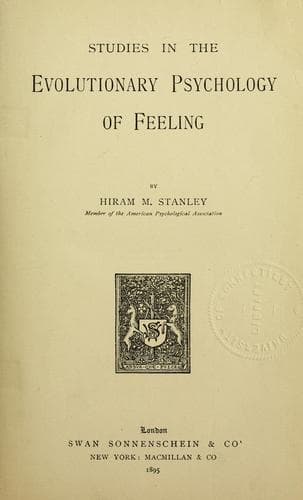
Studies in the Evolutionary Psychology of FeelingStanley, Hiram Miner
Philosophy
Studies in the Evolutionary Psychology of Feeling
Stanley, Hiram Miner
Emotions
Science views the world as an assemblage of objects having mutual
relations. In this cosmos of interacting elements certain objects become
endowed with mental powers by which they accomplish self-conservation.
Just what these objects are and how they attain mental quality is beyond
our direct investigation. However, assuming consciousness as a purely
biological function, as a mode for securing favourable reactions, we can
discuss the probable course of its evolution under the law of
self-conservation. Mind, like all other vital function, must originate
in some very simple and elementary form as demanded at some critical
moment for the preservation of the organism. It is tolerably obvious
that this could not be any objective consciousness, any cognitive act,
like pure sensation, for this has no immediate value for life. It was
not as awareness of object or in any discriminating activity that mind
originated, for mere apprehension would not serve the being more than
the property of reflection the mirror. The demand of the organism is for
that which will accomplish immediate movement to the place of safety.
The stone pressed upon by a heavy weight does not react at once to
secure itself, but is crushed out of its identity; but the organism
reacts at once through pain. It is certainly more consonant with the
general law of evolution that mind start thus in pure subjective act
rather than in mere objective acts, like bits of presentation or a
manifold of sense. We shall now endeavour to elucidate this conception
of pure pain as primitive mind, first from the general point of view of
the law of self-conservation, and secondly from particular inductive
considerations.
It is very difficult to conceive what this bare undifferentiated pain as
original conscious act was, it being so foreign to our own mental acts.
Our psychoses have a certain connection one with the other, and a
connection which is cognized as such, so that the whole of mental life
is pervaded by an ego-sense. But primitive consciousness must have been
by intermittent and isolated flashes. The primitive pain, moreover, was
not a pain in any particular kind, but wholly undifferentiated or bare
pain. There was no sense of the painful, but only pure pain. Nor was
there any consciousness of the pain, any knowledge or apperception of
it. The pain stands alone and entirely by itself, and constituting by
itself a genus.
Public-domain text, read in full here on John Shaqi.
Reviews
Reviews
No reviews yet
Be the first to share your thoughts on this work.
Join the Discussion
Join the discussion
Sign in to leave a comment or review.
Sign InorCreate an account