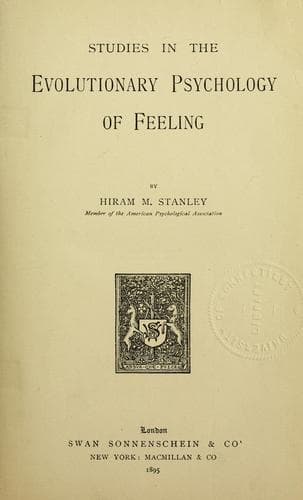
Studies in the Evolutionary Psychology of FeelingStanley, Hiram Miner
Philosophy
Studies in the Evolutionary Psychology of Feeling
Stanley, Hiram Miner
Emotions
If pure pleasure-pain is primitive consciousness (see chap. ii.), it
must be most rare phenomenon in such an advanced consciousness as that
of the human adult: and it is not surprising that one should search for
it in vain. But in any case it could not yield to attention. Attention
as cognition views its object in relation, in a _milieu_; it can
reproduce only by fastening upon something to reproduce by, but pure
pleasure-pain has nothing connected with it. Again, attention as
volition cannot reproduce mere pleasure-pain which is not volitional in
its origin and growth like sensing, perceiving, or ideating. We merely
“suffer” pain. Both pleasure and pain in themselves are purely passive;
willing cannot directly affect them, and they are not, like cognitions,
modes of volition, or effortful activities. For man to have a primitive
consciousness by exercise of will would be quite as difficult as to turn
himself into a protozoön.
Further, would not attention as introspective alertness to discover such
a fact of consciousness as pure pleasure-pain denote that consciousness
is thereby raised far above the level at which such a phenomenon can
occur? In general also constant introspective attention tends to defeat
itself. A continual intentness and watching for a given psychic
phenomenon is a state which, the more intense and persistent it is,
tends to bar out the particular state watched for, and, indeed, all
other states than itself. If attention as act engrosses, it defeats
itself.
If, however, undifferentiated pleasure-pain should at any time occur in
human consciousness, might we become immediately and spontaneously aware
of it? By its very nature it may escape conscious attentive
investigation, but may there not be a direct and simple awareness or
apperception of it? We might suppose that one man tells another, “I was
very sick, and in state of coma I had pain, merely pain, not any kind of
pain or pain anywhere, but just pain, that was all the consciousness I
had.” Such an expression is intelligible, and may be a fact. However, it
is in the phenomena of lapse and rise of consciousness that we see
evidences that undifferentiated feeling probably occurs, and that
sometimes in high psychisms. In the following chapter we discuss then
this point as a matter of judgment of tendencies, rather than on basis
of direct evidence of introspection, though this is not barred out.
CHAPTER II
_ON PRIMITIVE CONSCIOUSNESS_
Public-domain text, read in full here on John Shaqi.
Reviews
Reviews
No reviews yet
Be the first to share your thoughts on this work.
Join the Discussion
Join the discussion
Sign in to leave a comment or review.
Sign InorCreate an account