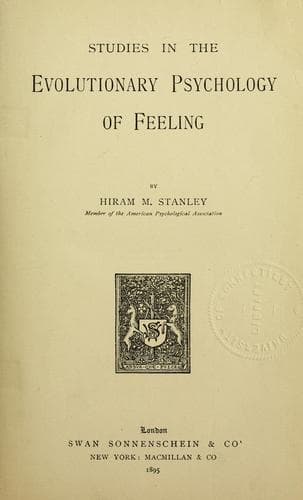
Studies in the Evolutionary Psychology of FeelingStanley, Hiram Miner
Philosophy
Studies in the Evolutionary Psychology of Feeling
Stanley, Hiram Miner
Emotions
The whole subject of mental differentiation needs clarifying. Are we to
consider mind merely as a sum of many distinct modes each of which has,
in the course of evolution, appeared suddenly in answer to the demands
of life at a critical period, and is faint, indeed, yet from the first
having a distinct and peculiar quality by which it suitably stimulates
will, and that the sole growth of these diverse forms has been in
intensity and by various associations with other states? or are we to
consider that mind was originally a very general vague state, which, by
a continuous and traceable differentiation, has slowly developed into
many different modes? Certainly the latter seems the more rational. To
conceive that there are no essential and radical subdivisions in mind,
that not even knowing, feeling, and willing, are fundamentally
primitive, but each, and each form of each, but modifications of
precedent modes, this is a theory which is enticing in its simplicity
and in its analogy to physical evolution from a single underlying
material element. But when we come to particular investigations, as this
of the origin and development of hate, we cannot well discover any modes
intermediate between it and say, anger, which are the links in a
continuous evolution, but for aught we can see or conceive, hate is as
much hate the first time it appears as at any subsequent time. The links
in the evolution of mind from phase to phase are all missing, and how
are we to supply them? Of necessity as subjective facts they must first
be realized, before they can be known, but how can this be done by a
consciousness which has long outgrown them? We cannot discover these
fossil and extinct forms objectively, as the paleontologist discovers
extinct species, but in some way we must re-enact and re-experience them
in our own consciousness before we can know anything about them. If
every mind embryologically passes through the several stages of its
general evolution in the race, still the strange intermediate forms
which might then have existed are beyond the recall of the reflective
stage, when we first demand to know the history of mind. And when we
appeal to comparative psychology we are equally in the dark, for we must
judge animals by ourselves, we can interpret their consciousness only by
our own, and they may have very rude and peculiar forms which are
unknown and unknowable by us. Thus the limitations and difficulties of
subjective research are especially brought up to us in evolutionary
study which thus seems wholly confined to _a priori_ speculation. While
we can conceive it likely that hate was suddenly brought into full being
by the demands of life, yet it is hardly a rational view of emotion to
regard it as a _per saltum_ series of distinct psychical species called
successively into being by the exigencies of existence, which indeed, is
a view almost as ultra-scientific as that which regards all mental modes
as direct endowments from Deity.
Public-domain text, read in full here on John Shaqi.
Reviews
Reviews
No reviews yet
Be the first to share your thoughts on this work.
Elsewhere in the archive
Join the Discussion
Join the discussion
Sign in to leave a comment or review.
Sign InorCreate an account