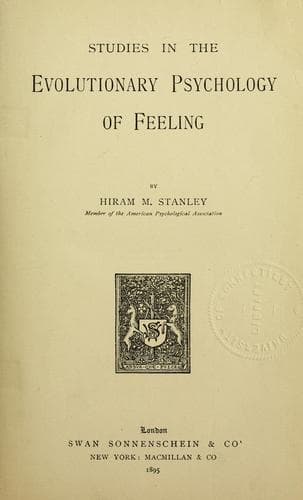
Studies in the Evolutionary Psychology of FeelingStanley, Hiram Miner
Philosophy
Studies in the Evolutionary Psychology of Feeling
Stanley, Hiram Miner
Emotions
While the novel in this way as change pleases, yet there is no pleasing
sense of novelty. Sensations, sights, sounds, tastes, etc., please by
their novelty, there is a pleasure in the sensations not merely
intrinsic but relative to previous experiences, but the mind is not yet
capable of the emotion of novelty which belongs to reflective
consciousness. The child may be pleased by the novel, but is not
consciously charmed by the novelty. The sense of experience as novel,
and as such pleasing, belongs to a higher grade of consciousness than
the naïve direct consciousness of the child. Novelty consciously known,
appreciated, and sought for its own sake is a decidedly late evolution.
There is an emotion and emotion of pleasure which we may feel in view of
the novel _per se_. Not merely the new object becomes the stimulant of a
new and refreshing experience, but this experience being known as novel
by the reflecting consciousness, and contrasted with other experiences,
there comes therewith a peculiar ripple of pleasurable emotion, the
emotion of the novel. The first emotion of novelty is itself thereby a
novel consciousness which might be, to a very reflective self-conscious
mind, an object for another emotion of novelty. In touching upon the
emotion of novelty we have thus risen beyond the common course of
natural selection, to the point where experience values itself for its
own sake.
In contrast to the emotion of novelty is the emotion of familiarity.
This might be discussed in a strictly parallel way to our discussion of
the emotion of novelty. It is founded upon likeness, being the sentiment
of likeness. An absolute novelty, the perfectly new, is of course
imperceptible as such, and by the law of continuity cannot occur in
nature. Some correlation with past experience is required to make the
thing cognizable at all, as is also some measure of unlikeness to make
it distinguishable and so familiar. The emotion of familiarity is much
neglected by psychologists, yet it forms a more important and a larger
element in the pleasures of advanced mind than the emotion of novelty.
Many of the delights of home and domestic life are tinged by it. The
pleasing sense of familiarity is, of course, most felt in contrast after
some long experience of novelties, as when the traveller returns home
from a prolonged journey. Delight in the familiar for its own sake often
largely prompts to the revisiting old scenes and renewing old habits.
The emotions of novelty and familiarity have a constant contrasting play
in many men. The familiar which is painful in itself may yet, like the
novel painful in itself, be pleasurable. We often welcome the familiar
and novel purely for their own sake whatever be their actual
hedonalgic[C] content.
[Footnote C: This adjective, which I used before seeing Mr. Marshall’s
“algedonic,” more exactly expresses pleasure—pain quality.]
Public-domain text, read in full here on John Shaqi.
Reviews
Reviews
No reviews yet
Be the first to share your thoughts on this work.
Elsewhere in the archive
Join the Discussion
Join the discussion
Sign in to leave a comment or review.
Sign InorCreate an account