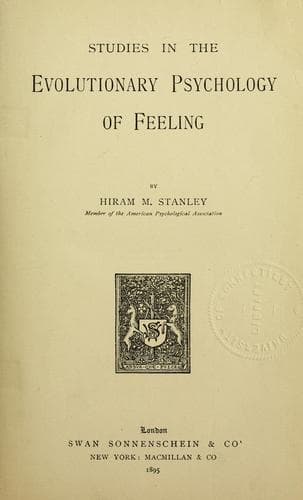
Studies in the Evolutionary Psychology of FeelingStanley, Hiram Miner
Philosophy
Studies in the Evolutionary Psychology of Feeling
Stanley, Hiram Miner
Emotions
Noticed familiarity like novelty may be painful. The disgusting emotion
by which we may meet the unwelcome novelty, has its correlate in the
wearing sense of monotony from the regular return of the familiar even
though it be intrinsically pleasurable.
In the reflective emotions we have touched upon but a single group, the
novelty-familiarity, which is certainly a complex but interesting kind
of psychoses. In all this field we have rightly to separate mere
sensitiveness to likeness and unlikeness—a tolerably early
phenomenon—from sense of relatedness and unrelatedness of experiences in
and for themselves. Consciousness of experience as such is the mark of a
radically new type of consciousness, quite set off from the naïve
unreflecting consciousness under the primitive conditions of natural
selection and the struggle for existence. The significance of this, by
which experience rests purely upon itself and is for itself, leads into
a wide region. It is enough that we have instanced one of these later
emotions in contrast to the directly serviceable emotions which have
most concerned us in our present discussions, without inquiring closely
into its function. It is evident that in the ordinary course of
evolution the character of the situation as affecting life determines
the serviceable emotion, thus different kinds of harmful situations
determine fear, anger, hate, etc. If a situation is really interesting
for life, it ultimately will be both known and felt in the progress of
the struggle for existence just as surely as light, colour, sound, etc.,
are gradually appreciated. Hence we might predict that the novel
situation and the incongruous situation would receive some advantageous
cognitive and feeling response, and that even emotions of novelty,
familiarity, congruity, and incongruity, would arise, as well as the
feelings for these things, if this were useful; that is, experience may
ultimately consciously react upon itself in these ways as well as
directly sense mere objects. Now the pleasure in novelty for its own
sake, while not consciously in the region of natural selection, yet
indirectly may be favoured by it as propædeutic to progressiveness. It
would, indeed, from one standpoint seem possible to deduce according to
the law of serviceability the whole course of experience past, present
and future, and we might as assuredly predict particular feelings as we
may predict the evolution of the wing or the hoof or the four-ventricled
heart in the course of a physical biologic evolution. The psychic
biologic evolution is to a certain point as strictly interpretable by
the principle of advantageous natural selection as the physical, for the
two are really co-ordinated. In the near future of psychology every
psychosis in its origin and development will be as clearly traceable as
any purely physiological organ, though this can never be accomplished in
the purely objective manner, but will require a subjective manipulation
Public-domain text, read in full here on John Shaqi.
Reviews
Reviews
No reviews yet
Be the first to share your thoughts on this work.
Elsewhere in the archive
Join the Discussion
Join the discussion
Sign in to leave a comment or review.
Sign InorCreate an account