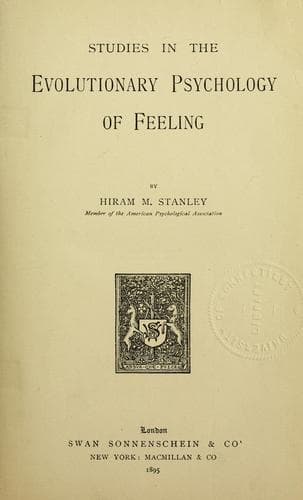
Studies in the Evolutionary Psychology of FeelingStanley, Hiram Miner
Philosophy
Studies in the Evolutionary Psychology of Feeling
Stanley, Hiram Miner
Emotions
which is now quite beyond us.
CHAPTER XII
_RETROSPECTIVE EMOTION_
Brown divided emotions into retrospective and prospective, but such a
classification has no basis in a general biological view nor yet in a
special analysis of the particular phenomena. It is evident that the two
great classes of emotion from the point of view of struggle for
existence will be response to injurer and to benefactor. These are the
two prime qualities in things for which emotional notice is most needed
as a service to life, and hence the broad and fundamental division of
emotion must always be into that which is response to the harmful and
that which is response to the beneficial. Here only is the great and
constant distinction in the nature of emotions. Prospect and retrospect
are equally meaningless in themselves considered. From a merely _a
priori_ biologic point of view we must, then, pronounce it quite
unlikely that the time-sense should fundamentally differentiate emotion,
but we should expect that the prime division would be with respect to
cognised injury or benefit.
That time-sense is not a grand principle of division we also see plainly
when we examine particular emotions. Thus, in the case of anger, while
we can say at once that this is, in all its forms, repulse to injury,
can we claim it is either prospective or retrospective emotion? The
truth is, the thought of injury done, doing, or to be done, equally
wakens anger in choleric individuals. The man who harmed me yesterday
excites my anger, and so does the man whom I perceive to be now injuring
me or about to injure me. The quality of the emotion is identically the
same whether the object be considered as in past, present, or future.
Even what seems to be a purely temporal emotion, like hope, which is
usually regarded as wholly prospective, may yet have other temporal
aspects. Thus, we sometimes say, “I hope it was not so,” where hope is
obviously retrospective, or more strictly prospective-retrospective,
having reference to expectation with desire that the event will turn out
not to have happened.
Public-domain text, read in full here on John Shaqi.
Reviews
Reviews
No reviews yet
Be the first to share your thoughts on this work.
Elsewhere in the archive
Join the Discussion
Join the discussion
Sign in to leave a comment or review.
Sign InorCreate an account