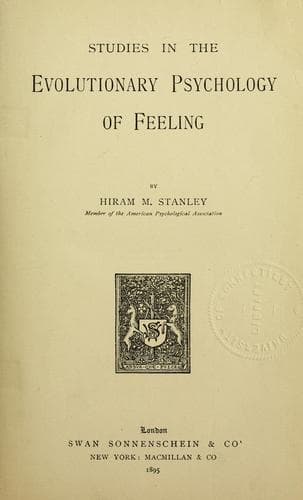
Studies in the Evolutionary Psychology of FeelingStanley, Hiram Miner
Philosophy
Studies in the Evolutionary Psychology of Feeling
Stanley, Hiram Miner
Emotions
But it may be said that, as emotion rests upon representation, the
proper classification of the emotions will depend upon the divisions of
representation which are essentially determined by the time-sense as
representation of past or future. Representation with sense of
representation implies a cognition of the thing as represented merely,
and so as non-existent to present actual sensing, as something having
been, or to be, sensed. The emotion arises thus on cognition of the
experienceable, and includes always some dim impression of potency of
object for harm or benefit at some time. However, though this may be the
case, it is plain that it makes no radical distinction in emotion. If a
man threatens me with some injury, this fires my rage, which is greatly
increased if I catch him in the act of committing the injury threatened,
or find that he has committed the evil deed. Change in time-sense may
thus bring change in intensity of some emotions, but it does not
determine quality of emotion. The prime factor as to kind of emotion is
always, not any sense of time, but the personal value of the event,
which may or may not receive a definite time determination. Indeed, a
form of representation, before any sense of experience as merely
subjective phenomenon is attained, is a prominent feature in the direct
naïve experience which constitutes by far the greater bulk in the total
existent consciousness. Before experience is aware of itself and of the
experienceable there is a certain purely subjective mirroring of that
which is not present to sense, but has been, _i.e._, there is a
re-occurrence in consciousness which has the subjective force of
reality; though the objective actuality is lacking, such re-occurrence
by association without the actual presence of the object stands,
however, for reality to the mind experiencing—it is a direct intuition;
the object, though unreal, is perfectly real to consciousness, and
conveys no meaning, and so is not a basis for emotion. Yet in the higher
representation with a sense of experience as integral element, the
representation is sometimes practically timeless, though surcharged with
emotion tendency. The highest objects which the mind represents have
little time quality, and all the nobler sentiments, as love of truth,
justice, etc., exist with little or no reference to time. So also in the
very earliest representation, the object is seen in its feeling
value—emotion basis—as soon as it is perceived as object; but this is as
an immediate subjective realizing in which time-sense plays very little
part. The conscious interpretation of past and future as a conscious
connecting of the two is certainly not a primitive function. The time
form is, then, on the whole, merely incidental in emotion, and is by no
means a fundamental principle determining classification.
Public-domain text, read in full here on John Shaqi.
Reviews
Reviews
No reviews yet
Be the first to share your thoughts on this work.
Elsewhere in the archive
Join the Discussion
Join the discussion
Sign in to leave a comment or review.
Sign InorCreate an account