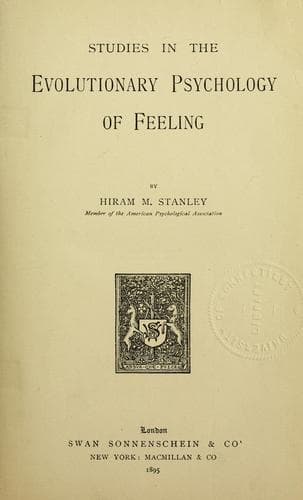
Studies in the Evolutionary Psychology of FeelingStanley, Hiram Miner
Philosophy
Studies in the Evolutionary Psychology of Feeling
Stanley, Hiram Miner
Emotions
Yet, though we must reject time as a cardinal principle of division in
emotion, still we must acknowledge that the term retrospective emotion
denotes a real group of mental phenomena, including revenge, regret,
remorse, and kindred forms, which are marked as feeling for the past
merely as past. However, pure retrospection is rare and late. The past
does not for primitive mind stand by itself as something to be dwelt
upon, to be thought about, to be moved by, and stirred to action. The
immediate present absorbs the mind, and the past interests and excites
only so far as bearing directly on the present. And so it is that the
child lives in the present, the youth and man in the future, the old man
in the past; and this denotes the relatively late appearance of pure
retrospection and of emotion founded thereon. Emotion is first merely
spectant, then prospective, then retrospective. However, when we say an
emotion is concerned solely with the present in the very young, we mean,
of course, the immediately prospective—that which has relation to but
one sense and by association rouses emotion, as an apple, seen or
handled by a child, awakens emotion, desire to taste. Where sense
consciousness is not multiform, but single and uniform, as, doubtless,
in very low organisms, there is no opportunity for any emotion, for
there is no interpretation power. But the intensification of some one
sense connection already attained may be a basis for emotion which we
may loosely call emotion spectant, as when the greedy child eagerly
eating an apple desires a larger bite, sweeter portion, etc.
However,—though it has little classification value,—emotion can be only
prospective or retrospective; and this is, of course, implied in its
basis—representation. Emotion by its very nature must be a looking
forward, or a looking backward, or both. As a feeling about, and not a
direct feeling, this is obviously its unvariable cognitive content. The
immediate and actual realization may be direct feeling or sensation, but
it is never in itself emotion. Emotion is always over something, an
experience of experience, and cannot thus be simple content. It is thus
a consciously idealizing mode as distinguished from direct realization
which is wholly self-contained.
Public-domain text, read in full here on John Shaqi.
Reviews
Reviews
No reviews yet
Be the first to share your thoughts on this work.
Elsewhere in the archive
Join the Discussion
Join the discussion
Sign in to leave a comment or review.
Sign InorCreate an account