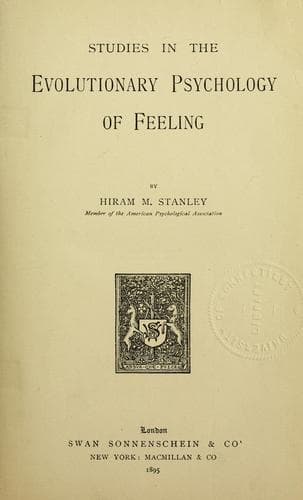
Studies in the Evolutionary Psychology of FeelingStanley, Hiram Miner
Philosophy
Studies in the Evolutionary Psychology of Feeling
Stanley, Hiram Miner
Emotions
any single element which can affect psychic life, as temperature, moves
through a highest pain intensity, an intermediate region, then to pain
again as effects in a range from a very high temperature to very low, or
_vice versâ_. Now, this gamut in a human being, from the intensest agony
from heat to the greatest suffering from cold, consists of very many
notes, but the step to unconsciousness is always at one end of the
scale. In lower psychic life it shortens, but always at the intermediate
points where pain merges into pleasure and pleasure into pain, and thus
in the lowest form the original element of consciousness as feeling is
seen when only the two extremes remain, namely, primitive consciousness
as pain reaction. As the step from feeling—consciousness to
unconsciousness is through a pain, this certainly points to pain as the
original feeling, and the first element of consciousness. We must
suppose then that the first organism which attained consciousness felt
pain, that if this came from temperature, for example, that intense heat
and intense cold would both produce a pain one and the same in nature,
bare pain, not sensation of heat or cold. And this pain-consciousness
response came at first only at the application of these critical
temperatures, all other degrees not bringing any response. If
consciousness like other functions originated as an infinitesimal germ
at some crisis in life, it must have been with pain. The pleasure
function, unlike the pain, does not originate in life and death crises.
That pleasure is secondary is also suggested by this, that pleasure is
mainly connected with such late formations as the special senses,
whereas pain is prominent with earlier functions. Thus we have pleasures
of taste, but visceral pleasure is scarcely noticeable, though visceral
pain, as colic, may be very acute. Wild animals, which feed often under
fear of interruption or in extreme hunger, bolt their food without
tasting, and so miss taste pleasure, and this seems to be the type of
primitive feeding.
The origin of pleasure is then, I think, to be traced as an intermediary
feeling between pain as produced by excess, and pain from lack as
differentiated form. Pain as original and undifferentiated is the same
whether resulting from excess or lack, but it is only after it has
differentiated so far as to be in two modes that pleasure can enter as a
mediate form of feeling and become a directing force to advantageous
action. The primitive pleasure-pain gamut was this:
LACK PAIN PURE PLEASURE EXCESS PAIN
──────────────┼──────────────┼──────────────
Public-domain text, read in full here on John Shaqi.
Reviews
Reviews
No reviews yet
Be the first to share your thoughts on this work.
Join the Discussion
Join the discussion
Sign in to leave a comment or review.
Sign InorCreate an account