Studies in the Evolutionary Psychology of Feeling — John Shaqi
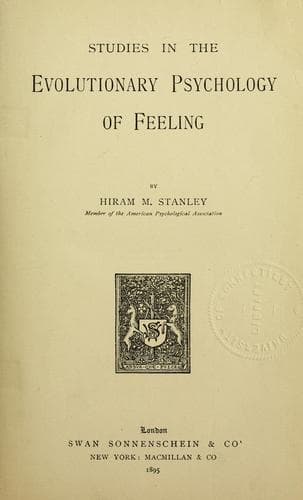
Studies in the Evolutionary Psychology of FeelingStanley, Hiram Miner
Philosophy
Studies in the Evolutionary Psychology of Feeling
Stanley, Hiram Miner
Emotions
A general survey from the point of view of self-conservation leads us
then to regard the original psychic state as a pain-effort form. There
is first a purely undifferentiated sense of pain and closely consequent
a purely undifferentiated _nisus_. There is neither sense of objectivity
in general, nor in any special mode, nor is there feeling of pleasure.
And the study of what seem to be the earliest forms of mental life in
the child and in the lower animals points toward this conclusion.
Preyer, in his studies on the mind of the child, expresses his
conviction that the feelings “are the first of all psychical events to
appear with definiteness,” and that at first in no manifold forms. He
adds, “The first period of human life belongs to the least agreeable,
inasmuch as not only the number of enjoyments is small, but the capacity
for enjoyment is small likewise, and the unpleasant feelings predominate
until sleep interrupts them” (_Mind of the Child_, Part I., New York,
1888, p. 143, _cf._ p. 185). Since in the embryology of the mind as in
that of the body the individual repeats in condensed manner the
evolution of life, we judge that these observations point toward the
genesis of consciousness in a single feeling state, pure
undifferentiated pain. The earliest consciousness we can discover seems
to approach this type. The close observer of very young infants must
feel that the meagre psychic life they may have consists mainly of
intermittent pains interrupted by comparatively long periods of
unconsciousness in sleep. Of course, the earliest psychic life of the
infant is not absolutely primitive both on account of heredity and on
account of pre-natal experience; but in its general form it, no doubt,
reverts toward the original _status_ of mind. This original state, to
which that of a very young infant is akin, was merely pain, which knew
not itself nor its relation to other states, nor its relation to the
external world, but was a wholly central subjective fact, and so was
expressed only in wild and blind general movements. The very lowest
types of psychic life which we can interpret seems to feel and nothing
more. They do not feel _at_ anything, and do not feel because they know,
nor do they have definite kinds of feeling.
Pure feeling as bare pain and as undifferentiated pleasure is certainly
far removed from our ordinary conscious experience, yet it may sometimes
appear in a survival form, especially in sluggish states, in waking from
sleep, and in recovering from anæsthetics. We are sometimes awakened by
a dull pain which was evidently in its inception mere bare pain without
differentiation. But in all such cases the pure pain or pure pleasure is
but momentary, and is quickly swallowed up in a flood of manifold
sensations. Many objects by many modes of sense at once invade and
possess consciousness, and the early indefinite mode vanishes so quickly
that we very rarely have time to note it by reflective consciousness.
Public-domain text, read in full here on John Shaqi.
Reviews
Reviews
No reviews yet
Be the first to share your thoughts on this work.
Join the Discussion
Join the discussion
Sign in to leave a comment or review.
Sign InorCreate an account