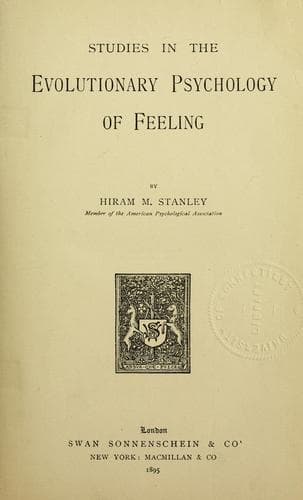
Studies in the Evolutionary Psychology of FeelingStanley, Hiram Miner
Philosophy
Studies in the Evolutionary Psychology of Feeling
Stanley, Hiram Miner
Emotions
Pain from restriction or intermission of some organic activity, as the
digestive and assimilatory, may then lead to sense of lack and desire
for object which is unrealized. However, craving-desire as implying
sense of loss, of something pleasurable missed, is not organic, but is
mere reflex of organization. It is not progressive, but conservative; it
does not initiate, it merely keeps the organism to its accustomed level.
This is the limited range of appetite. Craving rests on past evolution.
However, we have to explain the origin of those activities which, when
intermitted, produce such distressful results. We must first acquire the
liking before we miss what we like, and tastes uniformly originate
through effort, and all pleasurable activity is built up by painful
volition as urged by direct pains or by desires. Desire then is more
than craving. Craving as based on organic lack is satiable, desire is
insatiable. We desire what we have never missed and modes of experience
we have never attained. We, who have never had a gold watch, desire one,
and having received one, we lose it, miss it, and so desire is
reinforced. All the progressive activity of the human world originates
in desire, as ambition, or as desire of truth, virtue, etc. Here we do
not miss what we are accustomed to, but we are forming habits, which
will be the basis for cravings with descendants. For instance, one who
now does not miss beauty of art, but is ambitiously striving to
appreciate art, may come finally—or at least his descendants—to miss
art, and so to crave it. But for the time he has no art craving, only an
art desire. Of course all desire in the craving form, or in the higher
desire form, involves a missing actualization. All desire is
extinguished in realization. But this obviously does not destroy the
distinction of desire as based on craving, a spontaneous resultant from
integration, an intermittence of habit, and desire as itself integrating
habit-forming emotion.
Public-domain text, read in full here on John Shaqi.
Reviews
Reviews
No reviews yet
Be the first to share your thoughts on this work.
Elsewhere in the archive
Join the Discussion
Join the discussion
Sign in to leave a comment or review.
Sign InorCreate an account