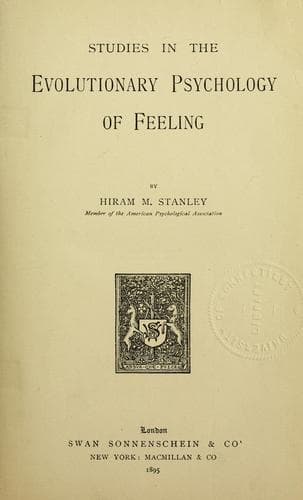
Studies in the Evolutionary Psychology of FeelingStanley, Hiram Miner
Philosophy
Studies in the Evolutionary Psychology of Feeling
Stanley, Hiram Miner
Emotions
Attention may also denote dominancy in consciousness. When any one
factor is pre-eminent, we say the mind is therewith attentive. When any
element has a marked ascendency, so that all others are much feebler and
subservient, thereby is constituted a state of attention; as when sight
perception monopolizes consciousness in an eagle watching for prey, or
hearing commands all the mental powers of a deer listening to a strange
sound. However, practically all states are in reality complexes in which
some one factor is and must be dominant, and this universal phenomenon
of dominancy scarcely deserves the specific name, attention.
Consciousness is always more or less concentrated in some single
channel; the factors in any state of consciousness are never perfectly
equal in intensity, and so are never in perfect balance. But attention
is not this fact of dominancy, but rather that of consciously sustained
dominancy, as we shall note later.
If attention is not a proper term to denote simple dominancy, may it not
denote that complete form, engrossment, or absorption, where one element
predominates to the exclusion of all others, and so occupies all of
consciousness—that is, more exactly, is all the consciousness—and also
tests the capacity for consciousness to the full? The fixed idea is an
instance in point, and in a certain way also preoccupation or
absent-mindedness. Still, in this last there are manifold elements and
often great complexity—_e.g._, train of thought—hence dominances of
different forms, but yet a persistence of a certain mode with
consciousness running at its full capacity, and the result being that
the general trend is not easily altered. In cases of fixed idea and
brown study we say, “his attention is fully occupied,” which means
nothing more than his mind or consciousness capacity is fully taken. I
do not see that we gain anything by using attention in the same sense as
these two general terms, mind and consciousness, which are surely
sufficient. Further, when one “loses himself in a subject,” the power of
self-activity, and hence power of real attention, is lost. Mental
activity which has slipped beyond the control of will is not in any true
and high sense an attending, nor is attention good term for
consciousness at saturation point.
Again, attention is often used to denote consciousness in its change
aspect. When a new consciousness comes in and supplants a former state,
we say, in popular but misleading phrase, “it takes or attracts his
attention,” as if attention were entity rather than activity. But when
we say that change of consciousness is change of attention, we really
add nothing; it is an identical proposition. Attention does not qualify
consciousness, but is merely synonym for it.
Public-domain text, read in full here on John Shaqi.
Reviews
Reviews
No reviews yet
Be the first to share your thoughts on this work.
Elsewhere in the archive
Join the Discussion
Join the discussion
Sign in to leave a comment or review.
Sign InorCreate an account