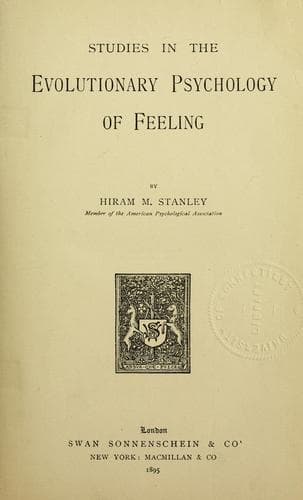
Studies in the Evolutionary Psychology of Feeling — John Shaqi
Studies in the Evolutionary Psychology of FeelingStanley, Hiram Miner
Philosophy
Studies in the Evolutionary Psychology of Feeling
Stanley, Hiram Miner
Emotions
The purely subjective experience, while it becomes more and more
evanescent factor as mind develops, yet always maintains its place as
the initial point and vanishing-point of every psychosis. Every
psychosis beyond the most primitive must be accounted a
feeling-will-knowing group. These psychic forces exist in a correlated
union generally comparable with the correlated activity of physical
forces like electricity and heat. Each psychosis repeats in itself, in
tendency form at least, the essential stages in the evolution of
consciousness. Every psychosis rises from the pure pleasure-pain as the
lowest level of mentality like a wave, and like a wave falls back into
it again. Every wave of consciousness, whether it rises slowly or
rapidly, whether it subsides gradually or violently, rises from pure
subjectivity and comes back to it again. This absolutely simple feeling
phase is accomplished so rapidly in ordinary human consciousness as to
be rarely perceptible, but in lower consciousness it often exists as
mood, as more or less permanent psychosis. The Brahmans attain
artificially a subjectivity akin to this through their expertness in
mental control and manipulation. They succeed in reducing and keeping
consciousness in some very simple type, and their Nirvana may be
considered as a state of pure subjectivity on the pleasure side. They,
of course, cannot really attain this state or, at least, keep it, for
pleasure is at bottom relative, yet they come to something approaching
it. Pain at its height just before unconsciousness is reached, is always
of the pure subjective type. In slow torture pain increases to a maximum
intensity in pure pain, beyond which there is a gradual loss of
intensity and consciousness in general, till ultimate failure of all
consciousness. From the maximum intensity on to the end, consciousness
is entirely subjective. Pleasure at its maximum attains only comparative
subjectivity. Such facts tend toward a theory of mind which makes its
original and fundamental act purely central; mind starts as in a germ
which pushes outward till it penetrates space and time, but not in any
reverse motion a pushing inward of a series of presentation forms.
Public-domain text, read in full here on John Shaqi.
Reviews
Reviews
No reviews yet
Be the first to share your thoughts on this work.
Join the Discussion
Join the discussion
Sign in to leave a comment or review.
Sign InorCreate an account