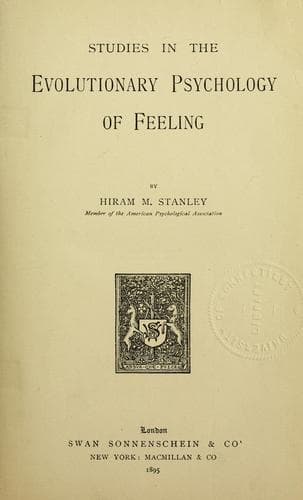
Studies in the Evolutionary Psychology of FeelingStanley, Hiram Miner
Philosophy
Studies in the Evolutionary Psychology of Feeling
Stanley, Hiram Miner
Emotions
It is commonly believed that attention to a feeling intensifies it—that
the more we attend to our feelings the stronger they are, and the less
attention we pay to them the weaker they are. A soldier wounded on the
field of battle heeds not the pain in the excitement of the conflict.
But the truth is in this case that he has no pain so long as he feels
none, and that he does not attend to the pain signifies simply that pain
does not become a psychic fact, but is wholly physiological, and so not
a subject for psychological discussion. This is a case of the confusing
use of attention for consciousness in general which we have before
criticised. Very often, indeed, such an expression as, “The more he
attends to his pain the more he has,” means simply, the more pain he has
the more he feels, an identical proposition. But we must also
discriminate between attention in a feeling and attention to a feeling.
I work myself up into a passion by strenuously dwelling on
representations involved in anger—this is an attention in a feeling; but
attention to anger would be self-observational effort. The former does
not involve consciousness of the feeling, the latter is nothing more
than strenuous consciousness of the feeling. Men are often angry without
being conscious of it or but dimly so, and attention to the feeling
would consist in intensifying by will effort this consciousness. When a
person says, “I was mad and I knew it,” he asserts the distinctness of
the acts and that the first does not always imply the second. This
cognition originally, like all cognition, required volition, and it is
still subject to volitional control and emphasis, that is attention,
even in advanced consciousness. Attention to a feeling is cognitive
effort in attaining or strengthening consciousness of feeling, hence is
but a mode of apperceptive or introspective effort.
We must distinguish sharply then between the observing act and the
observed feeling, between a cognition of consciousness of pain and a
pain consciousness, and we must note that attention may be either,
neither, or both. Apperception has become such a habit with higher human
consciousness that it is commonly exercised without attention, and so
has seemed to some as a necessary fact of all consciousness, an
anthropomorphism, which seems to us erroneous. When we are conscious we
are generally conscious that we are conscious; when a man has toothache
there is not only pain, ache, toothache, but consciousness of this as
fact of experience; but this does not establish apperception as fact of
all consciousness.
Public-domain text, read in full here on John Shaqi.
Reviews
Reviews
No reviews yet
Be the first to share your thoughts on this work.
Elsewhere in the archive
Join the Discussion
Join the discussion
Sign in to leave a comment or review.
Sign InorCreate an account