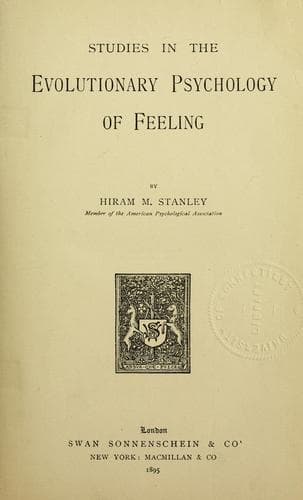
Studies in the Evolutionary Psychology of FeelingStanley, Hiram Miner
Philosophy
Studies in the Evolutionary Psychology of Feeling
Stanley, Hiram Miner
Emotions
Is it true now that the more we are conscious of a consciousness the
less we have of the latter? Certainly the more conscious we are of it
does not imply having the more of it, though we may say with truth that
within a limited range the greater and intenser the consciousness, the
greater the facility for consciousness of consciousness. A mental fact
must have a certain definiteness and prominence before it is clearly and
easily cognizable. However, speaking of the effect of apperception upon
the consciousness apperceived, it must be evident that it is always a
minifying and not a magnifying. Consciousness is self-divided when there
is both experience and consciousness of experience, hence a loss of
force for the consciousness cognized. A feeling self-consciously felt is
weakened thereby. The feelings we are most conscious of are of
comparatively low intensities. In very intense feelings we lose or
forget ourselves: we do not know what we are doing or feeling.
If now we make the consciousness of consciousness effortful, it is plain
that we diminish the consciousness cognized in still greater measure. A
consciousness of consciousness cannot be forwarded except at expense of
general mental capacity, and so as diverting force from the act
observed, whatever this be. Attention to a feeling must then on general
principles diminish the feeling, and that in a marked measure. The
psychologist who is always twigging his own consciousness to find out
what is going on there must often be surprised to find nothing there. It
is astonishing how fast feeling disappears when we begin to examine and
analyse it. The emotion fades the moment we turn attention to it. We
find that in psychological matters as elsewhere that we cannot have our
cake and eat it too. We murder to dissect. Apperceptive effort is never
intensification in the consciousness cognized, but cognition and
pleasure-pain feeling as a consciousness cognized lose in force, just as
in the body, an undue exaltation of one function is always a depressing
of others by withdrawal of force. The more conscious I am of my fear the
less I fear. While this law of withdrawal of force is obviously the case
when consciousness is at its fullest capacity, yet it may be said that
apperception in other phases acts as stimulant to waken latent forces,
just as in the body stimulus of one function is often stimulus of all,
though we doubt that apperception is original and permanent function in
consciousness. But still in such cases it is a new consciousness which
is stimulated and strengthened and not the consciousness which is being
cognized, and still more then is there decrease in the latter. A given
feeling is never increased by attentive consciousness of it. When a
feeling is said to be intensified by attention to it, we may suspect
either inaccurate analysis or misuse of terms. This, of course, does not
deny that within a certain range _immanent_ attention increases
Public-domain text, read in full here on John Shaqi.
Reviews
Reviews
No reviews yet
Be the first to share your thoughts on this work.
Elsewhere in the archive
Join the Discussion
Join the discussion
Sign in to leave a comment or review.
Sign InorCreate an account