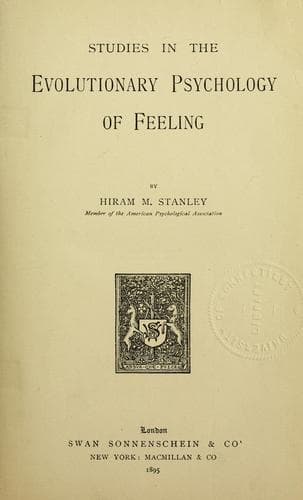
Studies in the Evolutionary Psychology of FeelingStanley, Hiram Miner
Philosophy
Studies in the Evolutionary Psychology of Feeling
Stanley, Hiram Miner
Emotions
pleasure, etc., for example, the more actively we taste an orange the
more taste pleasure we get.
We note in passing the very interesting psychological paradox that the
more we view ourselves the less we have to view, the principle of which
has been set forth above. We know well that the very reflective and
self-conscious have little personal force and individual quality.
Moreover the self-conscious stage in youth is precisely the period when
there is the least real self to be conscious of. A strong multiplex mind
is rarely very self-observant.
Finally we have to remark upon the way in which attention may be
divisive of cognition. Boswell makes Dr. Johnson to say, “If we read
without inclination, half the mind is employed in fixing the attention;
so that there is but one half to be employed on what we read.” But
admitting the necessity of intrinsic interest, this does not do away
with attention. Attention hinders rather than helps cognition only when
it becomes wearing strain, as in reading when much fatigued. But
attention as fulness of vigorous normal will activity gives a force and
value to cognition which it would not otherwise have, and often makes
its very existence possible. The greatest, most significant cognitions
in the mental life of any individual are those which are achieved at the
top of endeavour. Real knowledge as advancement and acquirement is
always the fruit of long training and attention.
The act of attention is painful and therefore is not exercised by lower
organisms, at least, only under absolute necessity. Often the pain from
attention is so great that the individual prefers to suffer than to
exert himself cognitively and so help to remove pain-giver. It is only
under the greatest pressure that new knowledge and new ideas are
acquired, and the history of mind shows a series of _tours de force_
achieved only in moments of direst need. The strengthening and the
holding of cognitive powers to a given point by effort of will is
peculiarly distasteful and painful activity. All minds tend toward
inaction or toward the regions of effortless action where overwhelming
interest carries them freely along. Attention, while the most
advantageous of actions, is yet most irksome and painful. It would seem
to us at first blush that if pleasure and not pain had attached to the
attentive act from the beginning, the evolution of mind would have been
accomplished in the merest fraction of the time actually required. It
would have been the difference between going down a steep incline rather
than up. Why progress should only be realized through painful effort and
struggle is a problem which has vexed the thought of man throughout
history but upon which psychology has little light to throw. Our present
concern is to simply emphasize the fact that cognitive act as attention
is always painful, and if the act of cognition is performed without pain
we may promptly deny this to be an attention. This is, of course, far
Public-domain text, read in full here on John Shaqi.
Reviews
Reviews
No reviews yet
Be the first to share your thoughts on this work.
Elsewhere in the archive
Join the Discussion
Join the discussion
Sign in to leave a comment or review.
Sign InorCreate an account