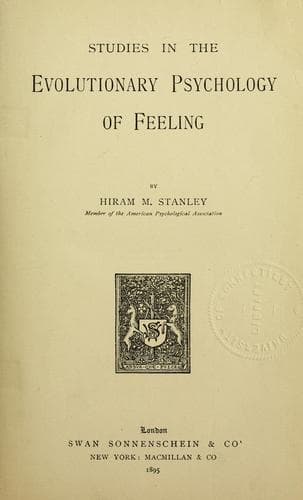
Studies in the Evolutionary Psychology of FeelingStanley, Hiram Miner
Philosophy
Studies in the Evolutionary Psychology of Feeling
Stanley, Hiram Miner
Emotions
Mr. Ward asserts that phenomena of pleasure and pain involve change in
consciousness with consciousness of change whereby we are pleased or
pained. A changing presentation _continuum_ is impressed upon mind, and
it is by awareness of these changes that feelings are caused. This is
certainly a complex mode to be assigned to all consciousness. This
asserts that primarily consciousness merely happens in presentation form
as determined from without, but I take it that the evolution of faculty
is always acquirement, not mind determined, but mind determining,
achieving its own growth in blind struggle. Mind is wholly an inward
growth, not a series of givens; and presentations are accomplished not
merely in it but by it. The fundamental principle is that while objects
do determine conscious functions, it is only through self-conservative
interest, through pleasure and pain reacting to them. All sensations,
intuitions, presentations, are at bottom achievements as forced by law
of struggle for existence. They do, indeed, seem to come of necessity
and spontaneously to adult human consciousness, but developed faculty by
virtue of being such does not have to attain beginnings.
But we note also this, that while all consciousness is change in the
sense of being dynamic, of being an activity, this does not include
consciousness of change. Consciousness as a changing factor is very
distinct from consciousness of that change, and does not necessarily
include or imply it. That the forms of activity which we group under the
general term consciousness have their existence wholly in movement and
change is true, but this does not necessitate that the changing elements
should be aware of the change as such. Different things may be felt and
known, but this does not always result in being known _as different_.
This brings in comparison, consciousness of relation, which is certainly
beyond primitive consciousness. In early mind we conceive that new
elements are continually taking the place of the old, that change is
incessant, yet without sense of the change. So far as the earliest
consciousness is spasmodic and intermittent, appearing in isolated
flashes, we cannot speak even of change in consciousness, much less of
consciousness of change, for there is no continuous thread, no
integration, consequently change is not in consciousness from a
consciousness to a consciousness, but the only change is from a
consciousness to unconsciousness. In the whole life of some organisms we
may believe that only three or four pains or pleasures occur, entirely
subjective and undifferentiated, and this collection of consciousnesses
where state does not follow and influence state, where there is no
complexity, is scarcely to be termed a consciousness which changes, much
less that is aware of change. It is not improbable that even with
civilized and educated men mind may sometimes lapse so far that changes
occur with no awareness of change. In such sluggish conditions as when
Public-domain text, read in full here on John Shaqi.
Reviews
Reviews
No reviews yet
Be the first to share your thoughts on this work.
Join the Discussion
Join the discussion
Sign in to leave a comment or review.
Sign InorCreate an account