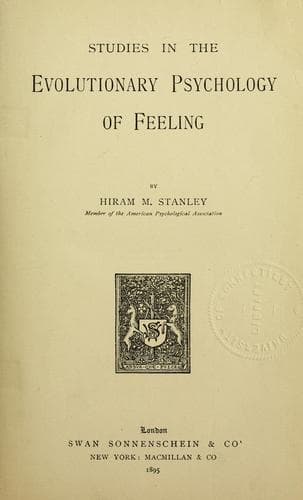
Studies in the Evolutionary Psychology of FeelingStanley, Hiram Miner
Philosophy
Studies in the Evolutionary Psychology of Feeling
Stanley, Hiram Miner
Emotions
Take a comparatively simple case. A child tastes an orange, and finds it
sweet, _i.e._, it relates the sweetness to the object, which relating is
a true thinking, an active conjoining or associating. Upon the
presentation of another orange to the child at a later date, he
identifies it as the sweet thing; he associates sweetness as to be
experienced from it on basis of past associating, that is, he makes an
induction. In this second orange-experience, as far as there is active
conjoining of mental products, a definite adding to present percept of
sweet taste as experienceable by conscious reference to former percept
(taste-experience), we must recognise a genuine thought-process. The
thinking consists in the joining of sensation of taste to an object, not
as a present, but as a future experience, on the basis of some past
experience. Here is a true mediation or reasoning of inductive type, and
also a true concept-process, that is, a taking together, a conscious
uniting, although the product is still particular. The nearest approach
to expressing this psychological process in language is to say, “This
round yellow is this sweet, because this round yellow was this sweet
before.” The correlating process rests upon the relating process
accomplished at first experience of orange-tasting, whereby the taste
was related to the thing tasted. This relating may be thrust upon the
mind, or the mind may consciously and actively assimilate. Thought in
the wide sense of the term may be made to include all mediate or
immediate conscious conjoining of experiences, whether the product be
general or particular.
Public-domain text, read in full here on John Shaqi.
Reviews
Reviews
No reviews yet
Be the first to share your thoughts on this work.
Elsewhere in the archive
Join the Discussion
Join the discussion
Sign in to leave a comment or review.
Sign InorCreate an account