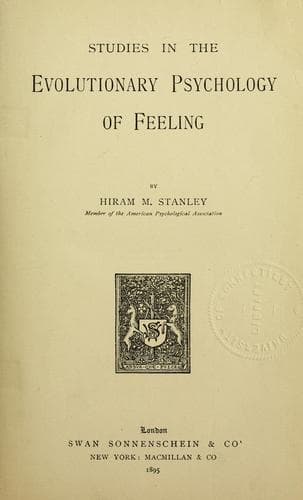
Studies in the Evolutionary Psychology of FeelingStanley, Hiram Miner
Philosophy
Studies in the Evolutionary Psychology of Feeling
Stanley, Hiram Miner
Emotions
Mediacy is certainly, however, accomplished before commonness is noted,
which in ordinary usage is concept-making. The grouping of the
particular taste with the particular sight and touch on basis of past
experience does not give a general result. The mediate term of past
experience of taste which the child brings up on sight of orange and
applies to the present case does not suggest commonness, but constancy
of experience, for at first it knows things only as identical, and not
as separate, or as like or unlike. The method of this early intelligence
is that of identifying, “The orange was sweet and is sweet”; and not
that of common characterizing, “Oranges are sweet, and this is an
orange.” The child does not discriminate or understand that the object
of its first experience is, by reason of this experience, no longer to
be experienced; it has not attained notion of disappearance. It does not
cognize the orange as one of a group or class, having as common
characters roundness, sweetness, and yellowness, and from presence of
round-yellow in any instance infer sweet; but it knows orange only as
this particular object of past, present, and future experience. Many of
the early thought-experiences of children are to be interpreted rather
upon this identity-method than upon the usual interpretation of true
concepts. Thus the child who calls every person of certain age, dress,
etc., “Papa,” is not thinking of a papa, or class of papas, but of the
papa. This is mistaken identity: the common and like is the same, and
the child requires considerable discrimination before it attains to
notion of papa in general. Same and not-same are discriminated before
like and unlike, and hence young children use common names as proper.
Now the mental product achieved by the child, which, as expressed in
words, we term the papa, may be styled a particular concept, a gathering
together of sight-sensations, and associating sound- and
touch-sensations with these so that any generally like group of
sight-sensations enables the child to call up on basis of past
experience the associated sound and touch, to expect the gentle word and
caress. The child in identifying the orange, “This round yellow thing is
the sweet thing,” is bringing together with a certain general force, not
of common characterization, indeed, but of temporal significance as
permanent grouping. Animals and young children think mostly on the
identifying plan; they join to and expect for a present experience what
has been conjoined with it in past experience, but the object is the
same, not a like one.
Public-domain text, read in full here on John Shaqi.
Reviews
Reviews
No reviews yet
Be the first to share your thoughts on this work.
Elsewhere in the archive
Join the Discussion
Join the discussion
Sign in to leave a comment or review.
Sign InorCreate an account