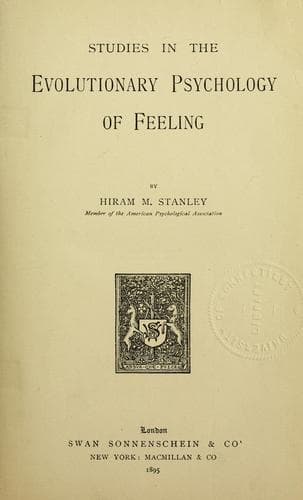
Studies in the Evolutionary Psychology of FeelingStanley, Hiram Miner
Philosophy
Studies in the Evolutionary Psychology of Feeling
Stanley, Hiram Miner
Emotions
But while the nature and rise of ethical emotion is often untruly
connected with some one kind of act, as obedience, or with some one kind
of motive, as love of reward, a far more likely field of investigation
is opened by those who connect feeling of duty with conflict of motives.
Yet it is obvious at first sight that mere opposition of any two psychic
factors is not a distinct feeling. I have seen my dog run away from me
to follow some canine friend, and then back to follow, and so on, till
one affection became dominant force; but such simple interference of
emotions does not constitute any third and new or higher emotion.
Conflicts of this sort in higher natures have sometimes a reflex
psychosis in painful feeling of distraction and bewilderment, but this
is the end of the natural course of feeling conflicts.
There are, however, higher phases of conflict of motives which may bring
us nearer to ethical emotion. A burglar, the evening he is to crack a
safe, is inclined to indulge in several glasses of wine, but his
companion remarks that he ought not to drink if he expects to do the
job. Here is something to be done, a duty, and under the compulsive
force of the feeling of this duty the burglar lays down his glass
untouched. Is not the psychic phenomenon really a case of the ethical
emotion as involved in the thwarting of present inclination for the
right carrying out of the thing to be done? A feeling for that which is
laid upon us to be done, whether we lay it upon ourselves, or it is laid
upon us by others, has certainly the compulsory quality which we
commonly attribute to the ethical emotion. When we have set out to do
something, this pre-determination exercises a peculiar pressure when
some diverse inclination enters, but it is the force of firmly-formed
purpose and of tenacious will. Its compulsiveness is not ethical, but
volitional. A very little reflection convinces me that something to be
done, and something which ought to be done, incite distinct emotions. I
feel differently when I go to church, because I have planned to go, or
have been told to go, and when I go simply because I feel I ought. There
is also superadded, the purely impulsive force of the emotion for the
larger good; and this may, indeed, play the whole part in the contest
with present inclination, which contest then becomes of the simple
alternating order. Thus the burglar has avaricious visions of gold, and
relaxes his cup; he looks at the tempting wine, and grasps it again, and
so on.
Public-domain text, read in full here on John Shaqi.
Reviews
Reviews
No reviews yet
Be the first to share your thoughts on this work.
Elsewhere in the archive
Join the Discussion
Join the discussion
Sign in to leave a comment or review.
Sign InorCreate an account