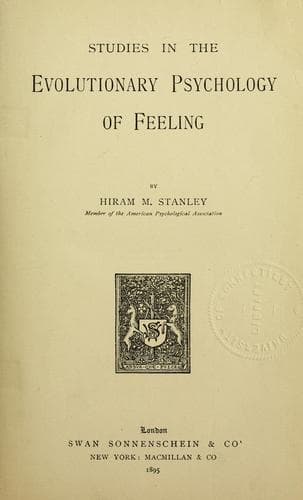
Studies in the Evolutionary Psychology of Feeling — John Shaqi
Studies in the Evolutionary Psychology of FeelingStanley, Hiram Miner
Philosophy
Studies in the Evolutionary Psychology of Feeling
Stanley, Hiram Miner
Emotions
The largest and keenest sort of pleasures is from expenditure. Yet
storage in certain modes yields a moderate pleasure, as the pleasure of
rest, dozing after exercise. Here is a general spontaneous accumulation
of physical pleasure capacity, it is a case where functional repair has
become automatic, and thus far is analogous to the spontaneity of
pleasures of expenditure. But these storage pleasures are mainly
negative, relief only; and they are not the great positive corporeal
pleasures which are so largely sought. The drunkard gradually recovering
from a spree experiences feelings of relief, but he does not indulge in
his cups to feel the gradual recovery from the painful after effects.
No biologic or psychologic theory of pleasure and pain can yet be
enunciated which is fully explanatory. In fact, if pleasure-pain is the
primitive and fundamental fact, if it constitutes the worth of life and
is life, then it must explain other factors, but remain itself
unexplained. The theory of advantage and disadvantage fails signally,
for the most pleasurable act is frequently the most disadvantageous to
the interests of the organism, and the most advantageous—progressive
effortful volition—is invariably most painful. As to why the way of
conservation and upbuilding should be painful, why pleasure should not
be inherent in the progressive struggle rather than pain, is, at least
for the present, a philosophical problem; but the fact remains. We have
considered that struggle is pain-impelled and painful, and that pleasure
is resultant of functioning thereby established, and that all pleasure
capacity is painfully acquired. With the grand exception of this
singular and important fact, however, we can say that in natural
evolution—that is, before mind has become independent and artificial and
subjected itself to pathologic tendencies—the general law that pleasure
denotes favouring organic conditions, pain, unfavourable, may be
assumed. However, if the body is mere dependency and expression of mind,
the form of statement must be reversed; that is, a given pain or
pleasure is an acquirement by mind in its function building. I have
painful taste sensation of bitter, pleasant sensation of sweet, not as
originally reflex of bodily conditions, but the sensing power and the
organ, like all bodily specialization, is outcome of mind as struggle. A
typical consciousness—series of a low type which places pleasure in its
place is: pain (as from hunger)—struggle-sensing (as touching for
food)—desire (when food is recognised through sensing)—absorptive and
digestive effort and action—pleasure—struggle to continue and increase
pleasure—slight satiety pain—unconsciousness of sleep. So we do not
connect pleasure-pain as outcome of organic function in general or
particular, but function is outcome of pleasure-pain. It determines
function, and not function it. The feelings which prompted and developed
a functioning, and the correlate total—organism—necessarily involve a
Public-domain text, read in full here on John Shaqi.
Reviews
Reviews
No reviews yet
Be the first to share your thoughts on this work.
Join the Discussion
Join the discussion
Sign in to leave a comment or review.
Sign InorCreate an account