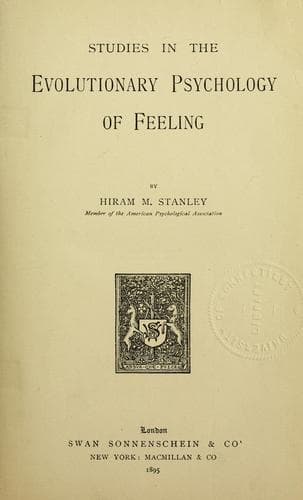
Studies in the Evolutionary Psychology of FeelingStanley, Hiram Miner
Philosophy
Studies in the Evolutionary Psychology of Feeling
Stanley, Hiram Miner
Emotions
very high complex, at least for any late psychism, and make a general
law of pleasure-pain impossible to determine under present conditions.
The _rationale_ of particular pleasures and pains can only be reached
through a thorough investigation of life history, an investigation which
in present circumstances seems in most cases beyond our powers. A great
mass of psychological _data_, and not any general theory, is the
_desideratum_.
CHAPTER IV
_THE RELATION OF FEELING TO PLEASURE-PAIN_
Should the term Feeling be made to include certain states of
consciousness which are neither pleasurable nor painful? Or should all
such neutral states be designated by some other term? We are concerned
here with an important matter of definition which implies an extensive
analysis of consciousness with reference to pleasure and pain. It will
not be difficult to find many so-called feelings which are neutral, or
seem to be so; but it is the duty of the psychologist to carefully
analyse all such states, and point out the proper use of the term
Feeling.
Common observation neglects minute analysis, and is unreliable when it
speaks of certain indifferent states as feelings. When a man speaks of
feeling queer, or strange, or bewildered, or surprised, and says that
the state of mind seemed neither agreeable nor disagreeable, we may
suspect that by a perfectly natural tendency he is extending the name
Feeling to closely-connected states of cognition or will. In
identification and definition common observation is for all sciences
notoriously untrustworthy, and especially in psychology; so on this
question the evidence of language and popular testimony counts for
little one way or the other. This is strikingly evident when people
speak of feeling indifferent as to some matter, meaning that they have
no feeling on the matter. The term Feeling is used in such a broad and
vague way that ‘I feel indifferent’ means ‘I am indifferent,’ ‘I have no
feeling.’ The mistake here is in using the word Feeling as an equivalent
to Ego, or any quality of Ego. A feeling of indifference is no feeling
at all. Popular evidence then, I believe, can be no guide in this
matter. In passing, I may also say that the very abundant use of analogy
by some writers on this subject seems to me ill-advised. Analogy does
very well to bring up the rear, but it is often very useless and
confusing as an advance-guard.
Public-domain text, read in full here on John Shaqi.
Reviews
Reviews
No reviews yet
Be the first to share your thoughts on this work.
Join the Discussion
Join the discussion
Sign in to leave a comment or review.
Sign InorCreate an account