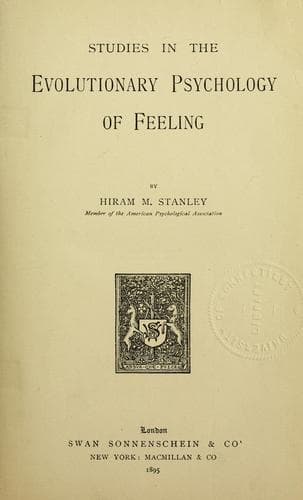
Studies in the Evolutionary Psychology of FeelingStanley, Hiram Miner
Philosophy
Studies in the Evolutionary Psychology of Feeling
Stanley, Hiram Miner
Emotions
It would seem highly desirable, in order to keep clear the distinction
between intensity and feeling-of-intensity, to restrict the term
Excitement to the latter meaning, and substitute the general term
Intensity for all objective excitement so-called. It is also greatly to
be desired that the reflex states which arise from sudden or great
changes in quality, quantity and intensity of consciousness, and which
are commonly termed feelings, should receive more general attention from
psychologists than heretofore. I have in this paper essayed something in
this direction, but it is a very large field, and comparatively
unexplored.
However, so far as the problem of feeling as indifference is concerned,
enough has been said on Excitement and Intensity, and I shall now
consider Neutralisation as giving neutral feeling, a method suggested by
Mr. Johnson (_Mind_, xiii. 82), and developed by Miss Mason (xiii. 253).
Does a feeling, neutral as regards pleasure and pain, result from the
union in one consciousness of a pleasure and pain of equal intensities?
Is there a composition of equal pleasure-pain forces so that resultant
equals zero? Such a question implies a clear apprehension of what is
meant by being in consciousness, and as to the possibility of perfect
coincidence and equality in mental activities. It is plain that so far
as consciousness is linear, neutralisation cannot occur. Where there is
but one track, and but one train at a time, collision is impossible.
Mental states often appear coexistent while they are really consecutive.
It is doubtful whether pain from toothache and pleasure from music ever
appear in absolute synchronism in consciousness, but they may alternate
so rapidly sometimes as to appear synchronous to uncritical analysis. To
a man drowning, a lifetime of conscious experience seems condensed into
a few seconds. This means a consciousness made very sensitive and very
rapid in its movement, and which acts like a camera taking pictures with
a lightning-shutter. Even if a pleasure and pain did coincide, it is
probable that in no case would they be exactly equal. In mental life as
in organic life every product has an individuality: as every leaf
differs from every other leaf, so every mental state is on completest
observation _sui generis_. This is evidently a most delicate
investigation, but I doubt whether it can ever be shown that two equal
pleasures and pains ever appear in the same sense in consciousness at
the same time. Practically equal pleasures and pains in consecutive
consciousness lead to vacillation, and the secondary pain of alternation
and excitement drives intelligent agents to new activity, or in stupid
agents the alternation may be carried to exhaustion.
Public-domain text, read in full here on John Shaqi.
Reviews
Reviews
No reviews yet
Be the first to share your thoughts on this work.
Join the Discussion
Join the discussion
Sign in to leave a comment or review.
Sign InorCreate an account