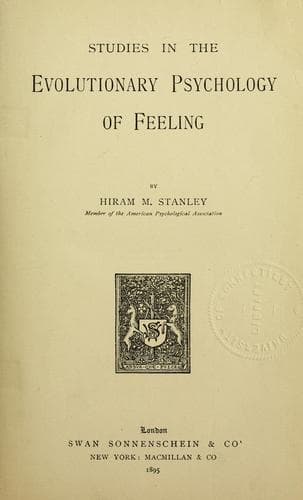
Studies in the Evolutionary Psychology of Feeling — John Shaqi
Studies in the Evolutionary Psychology of FeelingStanley, Hiram Miner
Philosophy
Studies in the Evolutionary Psychology of Feeling
Stanley, Hiram Miner
Emotions
It is undoubtedly true that consciousness, in all the higher forms at
least, is a complex; yet full and complete consciousness is probably of
one element only, and the remaining portion of the nexus grades off into
subconsciousness and unconsciousness. There is a network of coexistent
states of consciousness in different degrees in mutual reaction, each
striving for dominance but only one at a time reaching it. Some portions
of the nexus, as Ego-tone, are quite permanent elements. The light of a
large and brilliant consciousness may illumine a considerable area, but
brightness most certainly diminishes in rapid ratio as the distance
increases from attention, the single point of greatest illumination. A
highly developed brain may sustain a highly complex consciousness, but
it is only at the point of highest functional activity that we find the
physiological basis of a full consciousness. While high grades of mental
life are so complex, we do not find anywhere a mental compound. Two
diverse or opposite elements never combine into a compound which is
totally unlike either. Close analysis will fail to reveal any process of
neutralisation or combination whereby we experience neutral states of
feeling.
I have endeavoured to set forth the real nature of certain so-called
neutral feelings; but at the bottom the question is, as was at first
intimated, a matter of definition. Is it best to restrict the term
Feeling to pleasurable and painful states of consciousness, or is it
advisable for clearness and definiteness to widen the use of the
term so as to include certain neutral states? From such analysis as
has been made, I doubt the advisability. Appeal in such matters must
always be made to analysis, and the advantage must be shown for a
concrete example. The _a priori_ idea or general impression that
pleasure and pain is too small a basis for all feeling has no real
weight. Moreover, it must always be borne in mind that psychology,
like all other sciences, deals only with phenomena and not with
essences, not with mind but with mental manifestations, not with
feeling as mental entity having properties, being pleasurable,
painful, etc., but with these qualities in and for themselves. Thus
the metaphysical fallacy hidden in such common expressions as
“pleasurable and painful feelings” is to be constantly guarded
against. The feeling is not pleasurable or painful, but is the
pleasure or the pain. The feeling has no independent being apart
from the attributes which in common usage are attached to it, nor is
there any general act of consciousness with which these properties
are to be connected. As indicated at the beginning of this paper,
this common tendency has its psychological basis in the bringing
under the term Feeling some of the more permanent elements of
consciousness—especially the Ego-sense—which stand for metaphysics
as beings and entities having properties. Knowledge, Feeling, Will,
Public-domain text, read in full here on John Shaqi.
Reviews
Reviews
No reviews yet
Be the first to share your thoughts on this work.
Join the Discussion
Join the discussion
Sign in to leave a comment or review.
Sign InorCreate an account