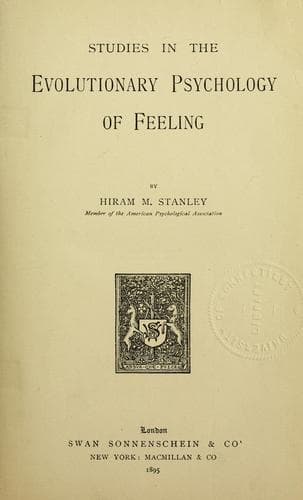
Studies in the Evolutionary Psychology of FeelingStanley, Hiram Miner
Philosophy
Studies in the Evolutionary Psychology of Feeling
Stanley, Hiram Miner
Emotions
But again, while differentiating act certainly pre-supposes the
undifferentiated, does it require coincidence? For instance, vision as
ordinary form, receiving impressions, certainly contains no _totum
objectivum_ activity, but also as differentiating act, as intense visual
effort reaching to higher development, it generally, at least, seems
free from any lower stage, and is engrossed in itself. Since we make the
prime cause of all mental development and differentiation in will, we do
not need any undifferentiated general ground remaining in consciousness
as basic element, nor does analysis of consciousness show this constant
element. Successive phases of presentation development are attained
through effort, but one does not gradually grow and branch out of the
other by a purely inward _impetus_ of its own. I believe, indeed, that
the inner life of mind consists in its original forms, and that they
remain in late mind not merely as useless survivals but having a
distinct functional value; but I do not see how any or all of the
general stages of mentality constitute _continua_ for consciousness of
higher types. Instead of being constant basal elements they occur and
are blotted out with such rapidity that reflection can very rarely
identify them (_vide_ p. 63). They are lost and swallowed up in complex
consciousness so quickly as to leave no trace upon memory, and they do
not subsist or continue throughout the complex forms. They are then the
very opposite of _continua_, being, in fact, the most evanescent of
mental phenomena. Consciousness in all higher forms, as the human mind,
must and does mount the main steps of its very early growth with
marvellous rapidity and leaves them entirely behind. The more primitive
the stage the more quickly it vanishes, till often it seems to appear in
tendency form only, or be thrown into a subconsciousness. Primitive
types exercise a most important but fleeting influence in advanced
consciousness which rises through them most rapidly and easily, but in
the less advanced the contrary is the case. The Australian savages, as
observed by Lumholtz, came to their senses and reached a full awakening
in the morning very slowly as compared with civilized men. With dull
children likewise we observe how slowly they awaken. All regressive
forms reach but slowly to their full consciousness and dwell long in
intermediate stages. But in all cases when higher forms enter the lower
disappears, when varied perception enters in awakening, then the
preceding dim general objectivity is wholly obliterated.
Public-domain text, read in full here on John Shaqi.
Reviews
Reviews
No reviews yet
Be the first to share your thoughts on this work.
Elsewhere in the archive
Join the Discussion
Join the discussion
Sign in to leave a comment or review.
Sign InorCreate an account