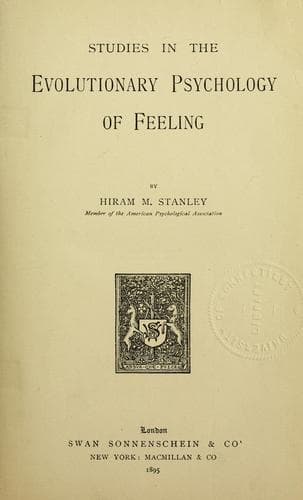
Studies in the Evolutionary Psychology of FeelingStanley, Hiram Miner
Philosophy
Studies in the Evolutionary Psychology of Feeling
Stanley, Hiram Miner
Emotions
Of course, the doctrine of relativity applies to introspection as to all
cognition, and subject _qua_ subject is as unknowable as object _qua_
object. We do not know feeling in itself, nor anything else in itself,
the subjective like the objective _ding an sich_ is beyond our ken. Yet
kinds of consciousness are as directly apprehended and discriminated as
kinds of things, but the knowing is, as such, distinct from the known
even when knowing is known. Here the act knowing is not the act known
and is different in value. The object known is not, at least from the
purely psychological point of view, ever to be confounded with the
knowing, to be incorporated into cognition by virtue of being cognized.
Feeling, then, seems to be as directly known by introspection and
reflection as any other process. It is not a hypothetical cause brought
in by the intellect to explain certain mental phenomena, but it is as
distinctly and directly apprehended as cognition or volition.
The distinction between having a feeling and knowing a feeling is a very
real one, though common phraseology confuses them. We say of a brave
man, he never knew fear; by which we mean he never feared, never
experienced fear, and not that he was ignorant of fear. Again, in like
manner, we say sometimes of a very healthy person, he never knew what
pain was, meaning he never felt pain. These expressions convey a truth
in that they emphasize that necessity of experience in the exercise of
the subjective method upon which we have already commented, but still
they obscure a distinction which must be apparent to scientific
analysis. We cannot know feeling except through realization, yet the
knowing is not the realization. Being aware of the pain and the feeling
pain are distinct acts of consciousness. All feeling, pain and pleasure,
is direct consciousness, but knowledge of it is reflex, is consciousness
of consciousness. The cognition of the pain as an object, a fact of
consciousness, is surely a distinct act from the pain in consciousness,
from the fact itself. The pain disturbance is one thing and the
introspective act by which it is cognized quite another.
Public-domain text, read in full here on John Shaqi.
Reviews
Reviews
No reviews yet
Be the first to share your thoughts on this work.
Join the Discussion
Join the discussion
Sign in to leave a comment or review.
Sign InorCreate an account