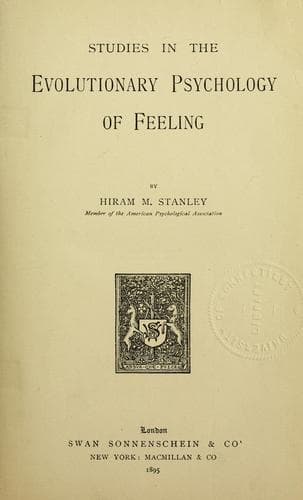
Studies in the Evolutionary Psychology of Feeling — John Shaqi
Studies in the Evolutionary Psychology of FeelingStanley, Hiram Miner
Philosophy
Studies in the Evolutionary Psychology of Feeling
Stanley, Hiram Miner
Emotions
These two acts are not always associated, though they are commonly
regarded as inseparable. It is a common postulate that if you have a
pain you will know it, or notice it. If we feel pained, we always know
it. This seemingly true statement comes of a confounding of terms. If I
have a pain, I must, indeed, be aware of it, know it, in the sense that
it must be in consciousness; but this makes, aware of pain, and knowing
pain, such very general phrases as to equal experience of pain or having
pain. But there is no knowledge in pain itself, nor pain in the knowing
act _per se_. The knowing the pain must be different from the pain
itself, and is not always a necessary sequent. We may experience pain
without cognizing it as such. When drowsy in bed I may feel pain of my
foot being “asleep,” but not know it as a mental fact. We may believe,
indeed, that pain often rises and subsides in consciousness without our
being cognizant of it, but, of course, in the nature of the case there
is no direct proof, for proof implies cognizance of fact. Pain as mental
fact, an object for consciousness, not an experience in consciousness,
is what is properly meant by knowing pain. Consciousness-of-pain as
knowledge of it is not always involved by pain-in-consciousness as
experience of it. Consciousness of pain by its double meaning as
cognizance of pain and experience of pain leads easily to obscurity of
thought upon this subject. But experience does not, if we may trust the
general law of evolution from simple to complex, at the first contain
consciousness of experience. This latter element is but gradually built
up into experience, though in the end they are so permanently united in
developed ego life that it is difficult to perceive their distinctness
and independence. That pain and pleasure are cognized as facts of
consciousness seems to us clear, but this does not deny that for us, at
least, they may be cognizable only in fusion with other elements, as
with sensation or volition. But whether known only with other elements
or not, pleasure-pain is equally known only by direct introspection. I
know directly and immediately pain and pleasure when I experience them,
though they always occur bound up with some sensation. It may be that I
never experience mere pain but some kind of pain, as a pricking pain,
burning pain, etc., and that I always recall pain by its sensation tone,
that I cannot isolate it by any act of attention. (E. B. Titchener,
_Philosophical Review_, vol. iii., p. 431.) However I know that I have
pain as well as I know that I have a pricking or burning sensation. “Did
you feel the prick?” “Yes.” “Was it painful or pleasurable?”
“Pleasurable”; such a common colloquy implies as direct consciousness of
the pleasure-pain as of the sensation. That I can at once discriminate a
sensation as either pleasurable or painful certainly shows a direct
awareness of pleasure-pain.
Public-domain text, read in full here on John Shaqi.
Reviews
Reviews
No reviews yet
Be the first to share your thoughts on this work.
Join the Discussion
Join the discussion
Sign in to leave a comment or review.
Sign InorCreate an account