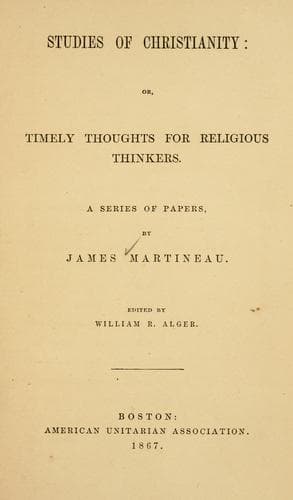
Studies of Christianity; Or, Timely Thoughts for Religious ThinkersMartineau, James
Religion
Studies of Christianity; Or, Timely Thoughts for Religious Thinkers
Martineau, James
Christianity; Church history -- 19th century
climax of souls whereon each below looks up and rises, yet each above
bends down and helps;--the discovery which brings such peace and
freedom to the heart, has been delayed by the mistaken identification
of the entire creed of the first age with the essence of Christianity.
Now that God has shown us so much more, has tried the divine seed of
the Gospel on so various a soil of history, and enabled us to
distinguish its fairest blossoms and its choicest fruits, a much
larger meaning than was possible at first must be given to the purpose
of his revelation. Even to Paul, Christ was mainly the great
representative of a theocratic idea; and was in no other sense an
object of _spiritual_ belief, than that he was not on earth and
mortal, but in heaven and immortal. That _faith_ in Christ, which then
prominently denoted belief in his appointed return, and _allegiance_
to him as God's viceroy in this world, is now transferred into quite a
different thing. It is altogether a moral and affectionate sentiment:
an acknowledgment of him as the highest impersonation of divine
excellence and inspired insight yet given to the world; a trust in him
as the only realized type of perfection that can mediate for us
between ourselves and God; a faithfulness to him, as making us
conscious of what we are and what God and our conscience would have us
to be. It is vain to pretend that revelation is a fixed and
stereotyped thing. It was born, as the divinest things must be, among
human conditions; and into it ever since human conditions have
perpetually flowed. The elements of Hebrew thought surrounded the
sacred centre at first, and have been erroneously identified with it
by all Unitarian churches in every age. The Hellenic intellect
afterwards streamed towards the fresh point of life and faith, and
gathered around it the metaphysical system of Trinitarian dogma in
which orthodox communions of all times have, with parallel error,
sought the essence of the Gospel. The true principle of the religion
has been _secreted in both, and consisted in neither_: it has lain
unnoticed in the midst, in the silent chamber of the heart, around
which the clamor of the disputatious intellect whirls without
entrance. The agency of Christ's mind as the expression of God's moral
nature and providence, and as the realized ideal of beauty and
excellence,--this is the power of God and the wisdom of God, which has
made vain the counsels of the world, and baffled the foolishness of
the Church. This is the Gospel's centre of stability,--"Jesus Christ,
the same yesterday, to-day, and for ever."
Few persons can be insensible to the sublimity of this expression upon
the relation between
CHRIST, NATURE, PROVIDENCE, AND GOD.
Public-domain text, read in full here on John Shaqi.
Reviews
Reviews
No reviews yet
Be the first to share your thoughts on this work.
Join the Discussion
Join the discussion
Sign in to leave a comment or review.
Sign InorCreate an account