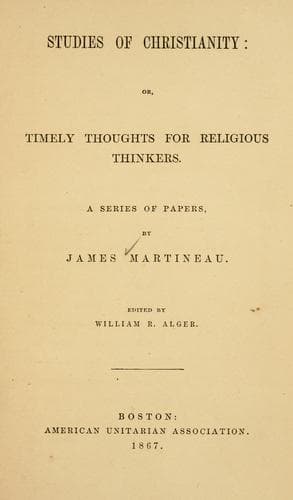
Studies of Christianity; Or, Timely Thoughts for Religious ThinkersMartineau, James
Religion
Studies of Christianity; Or, Timely Thoughts for Religious Thinkers
Martineau, James
Christianity; Church history -- 19th century
In conclusion, then, I revert, with freshened persuasion, to the
statement with which I commenced. Jesus Christ of Nazareth, God hath
presented to us simply in his inspired humanity. Him we accept, not
indeed as very God, but as the true image of God, commissioned to show
what no written doctrinal record could declare, the entire moral
perfections of Deity. We accept, not indeed his body, not the
struggles of his sensitive nature, not the travail of his soul, but
his purity, his tenderness, his absolute devotion to the great idea of
right, his patient and compassionate warfare against misery and guilt,
as the most distinct and beautiful expression of the Divine mind. The
peculiar office of Christ is to supply a new _moral_ image of
Providence; and everything, therefore, except the _moral_ complexion
of his mind, we leave behind as human and historical merely, and apply
to no religious use. I have already stated in what way nature and the
Gospel combine to bring before us the great object of our trust and
worship. The universe gives us the scale of God, and Christ, his
Spirit. We climb to the infinitude of his nature by the awful pathway
of the stars, where whole forests of worlds silently quiver here and
there, like a small leaf of light. We dive into his eternity, through
the ocean waves of time, that roll and solemnly break on the
imagination, as we trace the wrecks of departed things upon our
present globe. The scope of his intellect, and the majesty of his
rule, are seen in the tranquil order and everlasting silence that
reign through the fields of his volition. And the spirit that animates
the whole is like that of the Prophet of Nazareth; the thoughts that
fly upon the swift light throughout creation, charged with fates
unnumbered, are like the healing mercies of One that passed no sorrow
by. The government of this world, its mysterious allotments of good
and ill, its successions of birth and death, its hopes of progress and
of peace, each life of individual or nation, is under the
administration of One, of whose rectitude and benevolence, whose
sympathy with all the holiest aspirations of our virtue and our love,
Christ is the appointed emblem. A faith that spreads around and within
the mind a Deity thus sublime and holy, feeds the light of every pure
affection, and presses with omnipotent power on the conscience; and
our only prayer is, that we may walk as children of such light.
It seems as if no one capable of understanding could resist the
convincing cogency of the following exhibition of
THE IDEA OF VICARIOUS JUSTICE.
Public-domain text, read in full here on John Shaqi.
Reviews
Reviews
No reviews yet
Be the first to share your thoughts on this work.
Join the Discussion
Join the discussion
Sign in to leave a comment or review.
Sign InorCreate an account