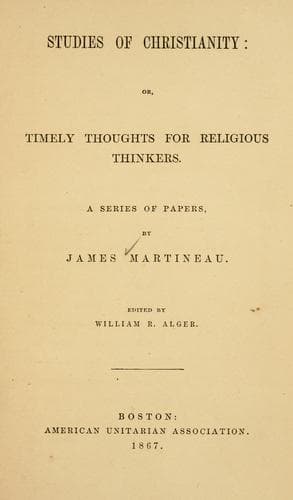
Studies of Christianity; Or, Timely Thoughts for Religious ThinkersMartineau, James
Religion
Studies of Christianity; Or, Timely Thoughts for Religious Thinkers
Martineau, James
Christianity; Church history -- 19th century
It is only natural that the parable of the Prodigal Son should be no
favorite with those who deny the unconditional mercy of God. The place
which this divine tale occupies in the Unitarian theology appears to
be filled, in the orthodox scheme, by the story of Zaleucus, king of
the Locrians; which has been appealed to in the present controversy by
both the lecturers on the Atonement, and seems to be the only
endurable illustration presented, even by Pagan history, of the
execution of vicarious punishment. This monarch had passed a law
condemning adulterers to the loss of both eyes. His own son was
convicted of the crime; and, to satisfy at once the claims of law and
of clemency, the royal parent "commanded one of his own eyes to be
pulled out, and one of his son's." Is it too bold a heresy to confess
that there seems to me something heathenish in this example, and that,
as an exponent of the Divine character, I more willingly revere the
Father of the prodigal than the father of the adulterer?
Without entering, however, into any comparison between the Locrian and
the Galilean parable, I would observe, that the vicarious theory
receives no illustration from this fragment of ancient history. There
is no analogy between the cases, except in the violation of truth and
wisdom which both exhibit; and whatever we are instructed to admire in
Zaleucus, will be found on close inspection to be absent from the
orthodox representation of God. We pity the Grecian king, who had made
a law without foresight of its application, and so sympathize with his
desire to evade it, that any quibble which legal ingenuity can devise
for this purpose passes with slight condemnation; casuistry refuses to
be severe with a man implicated in such a difficulty. But the Creator
and Legislator of the human race, having perfect knowledge of the
future, can never be surprised into a similar perplexity; or ever pass
a law at one time which at another he desires to evade. Even were it
so, there would seem to be less that is unworthy of his moral
perfection in saying plainly, with the ancient Hebrews, that he
"repented of the evil he thought to do," and said, "It shall not be,"
than in ascribing to him a device for preserving consistency, in which
no one capable of appreciating veracity can pretend to discern any
sincere fulfilment of the law. However barbarous the idea of Divine
"repentance," it is at least ingenuous. Nor does this incident of
Zaleucus and his son present any parallel to the alleged relation
between the Divine Father who receives, and the Divine Son who gives,
the satisfaction for human guilt. The Locrian king took a part of the
penalty himself, and left the remainder where it was due; but the
Sovereign Lawgiver of Calvinism puts the whole upon another. To
sustain the analogy, Zaleucus should have permitted an innocent son to
have both his eyes put out, and the convicted adulterer to escape.
Public-domain text, read in full here on John Shaqi.
Reviews
Reviews
No reviews yet
Be the first to share your thoughts on this work.
Join the Discussion
Join the discussion
Sign in to leave a comment or review.
Sign InorCreate an account