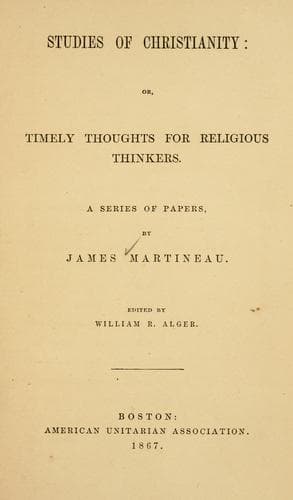
Studies of Christianity; Or, Timely Thoughts for Religious Thinkers — John Shaqi
Studies of Christianity; Or, Timely Thoughts for Religious ThinkersMartineau, James
Religion
Studies of Christianity; Or, Timely Thoughts for Religious Thinkers
Martineau, James
Christianity; Church history -- 19th century
All this difficulty is merely fictitious, arising out of the
determination to make out that God is both wholly Judge and wholly
Father; from an anxiety, that is, to adhere to two metaphors, as
applicable, in every particular, to the Divine Being. It is evident that
both must be, to a great extent, inappropriate; and in nothing, surely,
is the impropriety more manifest, than in the assertion that, as
sovereign, God is naturally bound to execute laws which, nevertheless,
it would be desirable to remit, or change in their operation. Whatever
painful necessities the imperfection of human legislation and judicial
procedure may impose, the Omniscient Ruler can make no law which he will
not to all eternity, and with entire consent of his whole nature, deem
it well to execute. This is the Unitarian answer to the constant
question, "How can God forgive in defiance of his own law?" It is not in
defiance of his laws: every one of which will be fulfilled to the
uttermost, in conformity with his first intent; but nowhere has he
declared that he would not forgive. All justice consists in treating
moral agents according to their character; the inexorability of human
law arises solely from the imperfection with which it can attain this
end, and is not the essence, but the alloy, of equity; but God, who
searches and controls the heart, exercises that perfect justice, which
permits the penal suffering to depart only with the moral guilt; and
pardons, not by cancelling any sentence, but by obeying his eternal
purpose to meet the wanderer returning homeward, and give his blessing
to the restored. Only by such restoration can any past guilt be effaced.
The thoughts, emotions, and sufferings of sin, once committed, are woven
into the fabric of the soul; and are as incapable of being absolutely
obliterated thence and put back into non-existence, as moments of being
struck from the past, or the parts of space from infinitude. Herein we
behold alike "the goodness and the severity of God"; and adore in him,
not the balance of contrary tendencies, but the harmony of consentaneous
perfections. How plainly does experience show that, if his personal
unity be given up, his moral unity cannot be preserved!
The author himself is the best exemplification of the man described in
this account of the
DIFFERENCE BETWEEN APPREHENSION AND INTERPRETATION.
Public-domain text, read in full here on John Shaqi.
Reviews
Reviews
No reviews yet
Be the first to share your thoughts on this work.
Join the Discussion
Join the discussion
Sign in to leave a comment or review.
Sign InorCreate an account