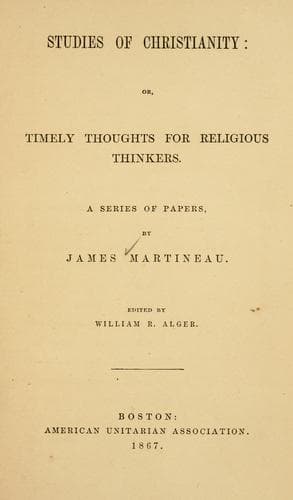
Studies of Christianity; Or, Timely Thoughts for Religious ThinkersMartineau, James
Religion
Studies of Christianity; Or, Timely Thoughts for Religious Thinkers
Martineau, James
Christianity; Church history -- 19th century
The difference between the ordinary visual gaze upon the external
universe, and the interpreting glance of science, is felt by every
cultivated understanding to be immeasurable;--and the contrast is not
less between that dull sense of what passes within him, which is forced
upon a man by mere practical experience, and the exact consciousness,
the discriminative perception, the easy comprehension of his own (and,
so far as they are expressed by faithful symbols, of others') states and
affections, possessed by the patient analyst of thought and emotion, and
careful collector of their laws. The mighty mass of human achievement
and human failure, in intellectual research, in moral endeavor, in
social economy and government, lapses into order before him, and
distributes itself among the provinces of determinate laws. The
structure of a child's perplexity, and the fallacies of the most
ambitious hypothesis, lie open to him as readily, as to the artisan a
flaw in the fabric of his own craft. The creations of art fall before
him into their elements; and, dissolving away their constituent
_matter_, which is an accident of their age, leave upon his mind their
permanent _form_ of beauty, as his guide to a true and noble criticism.
The progress and the aberrations of human reason, in its quest of truth,
are as clearly appreciated by him, as the passages of happy skill or
ignorant roving in some voyage of discovery, when the outlines and
relations of the sphere on which it is made become fully known.
Discerning distinctly the different kinds of evidence appropriate to
different departments of truth, and weighing the scientific value of
every idea and method of thought, he is not at the mercy of each
superficial impression and obtrusive phase presented to him by the
subjects of his contemplation; but he attains a certain rational tact
and graduated feeling of certainty in abstract matters of opinion, by
which he escapes alike the miseries of undefined doubt, and the passions
of unqualified dogmatism. In short, the great idea of Science is applied
by him to the complicated workings of the mind of man; interprets the
activities of his nature, and gives laws to the administration of his
life; and, with wonderful analysis, investigates the properties, and
establishes the equation, of their most labyrinthine curves.
What a rebuke upon dogmatic sciolists, what a glorious invitation to
study, are conveyed in the genial, broad, mental hospitality of the
succeeding paragraph!
NECESSITY OF LEARNING IN PHILOSOPHY.
Public-domain text, read in full here on John Shaqi.
Reviews
Reviews
No reviews yet
Be the first to share your thoughts on this work.
Join the Discussion
Join the discussion
Sign in to leave a comment or review.
Sign InorCreate an account