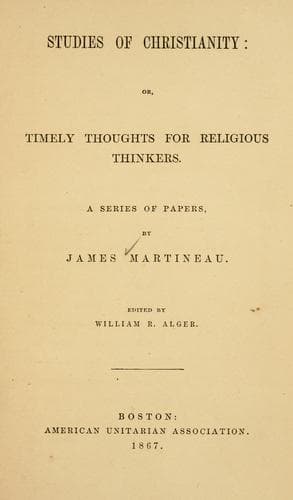
Studies of Christianity; Or, Timely Thoughts for Religious Thinkers — John Shaqi
Studies of Christianity; Or, Timely Thoughts for Religious ThinkersMartineau, James
Religion
Studies of Christianity; Or, Timely Thoughts for Religious Thinkers
Martineau, James
Christianity; Church history -- 19th century
Is it however true, that human belief can only choose between these
two extremes, and must oscillate eternally between the Atheistic
homage to Force, and the Pantheistic to Thought? Far from it; and it
is curiously indicative of the state of the philosophic atmosphere in
Germany, that one of her most discerning and wide-seeing authors
should find no third possibility within the sphere of vision. In any
latitude except one in which moral science has altogether melted away
in the universal solvent of metaphysics, it would occur as one of the
most obvious suggestions, that the intellect is not the only element
of human nature which may be taken as type of the Divine, and as
furnishing a possible solution to the problem of origination. Quitting
the two poles of extreme philosophy, confessedly incompetent in their
separation, we submit that WILL presents the middle point which takes
up into itself Thought on the one hand and Force on the other; and
which yet, so far from appearing to us as a _compound_ arising out of
them as an effect, is more easily conceived than either as the
originating prefix of all phenomena. It has none of the
disqualifications which we have remarked as flowing from the others
into their respective systems of doctrine. It carries with it, in its
very idea, the co-presence of Thought, as the necessary element within
whose sphere it has to manifest itself. Its phenomena cannot exist
_alone_; it acts on preconceptions, which stand related to it,
however, not as its source, but as its conditions, and are its
co-ordinates in the effect rather than its generating antecedents. If
therefore all things are issued by Will, there is Mind at the
fountain-head, and the absurdity is avoided of deriving intelligence
from unintelligence. While it thus escapes the difficulty of passing
from mere Force to Thought, it is equally clear of the opposite
difficulty of making mere Thought supply any Force. The activity of
Will is not, like that of Intellect, a subjective transit of
regimented ideas, but an _objective_ power _going out_ for the
production of effects; nay, it is a _free_ power, exercising
_preference_ among data furnished by internal or external conditions
present in its field; and it thus constitutes proper _Causality_,
which always implies control over an alternative. We need hardly add,
that all the requisites are thus complete for the true idea of a
_Person_; and an Infinite Being contemplated under this type is
neither a fateful nor a logical principle of necessity, but a living
God, out of whose purposed legislation has sprung whatever necessity
there is, except the self-existent beauty of his holiness. Thus,
between the Force of the physical Atheist, and the Thought of the
metaphysical Pantheist, we fix upon the fulcrum of Will as the true
balance-point of a moral Theism.
It would be impossible, perhaps, to find anywhere a finer instance of
perspicuity in condensation, than is given in the following reference to
Public-domain text, read in full here on John Shaqi.
Reviews
Reviews
No reviews yet
Be the first to share your thoughts on this work.
Join the Discussion
Join the discussion
Sign in to leave a comment or review.
Sign InorCreate an account