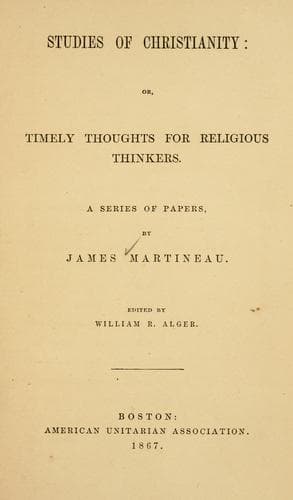
Studies of Christianity; Or, Timely Thoughts for Religious ThinkersMartineau, James
Religion
Studies of Christianity; Or, Timely Thoughts for Religious Thinkers
Martineau, James
Christianity; Church history -- 19th century
LESSING'S THEOLOGICAL CONCLUSIONS.
Lessing refused to surrender Christianity, on proof of error in its
first teachers, uncertainty in its reported miracles, contradictions
in its early literature, misapplication of Messianic prophecies. All
these he regards as but the external accidents, the transitory media,
of the religion, constituting, it may be, its support in one age and
its weakness in another. They do not belong to its inner essence, in
which alone the real evidence of spiritual truth is found; and he who
detects anything amiss with them may even render a service by driving
men from sham-proofs, that really persuade no one, to true ones that
lie at the heart of things. Religious doctrine cannot be deduced from
mere historical facts without a μεταβασις εις αλλο γενος vitiating the
whole process. _Facts_ indeed _may_ become the proper ground of moral
and spiritual faith; but then they must be facts which come over again
and again, and betray an element that is permanent and eternal; which
form part of the experience and consciousness of humanity; and ally
themselves with the Divine by not losing their _presence_ in the
world. But _unrepeated facts_, which limit themselves to a moment,
which are the incidents of a single personality, and are left behind
quite insulated in the past, show--were it only by your not expecting
them again--that they are detached from the persistent and essential
life of the universe and humanity. They are but once and away; and
least of all, therefore, can testify of the untransitory and
ever-living. The real can teach us only so far as it has an ideal
kernel, redeeming it from the character of a solitary phenomenon.
Among the various expositions and applications of this favorite theme
of Lessing's, we select the following sentences from his Axiomata.
1. "The Bible evidently contains more than belongs to Religion."
2. "That in this '_more_' the Bible is still infallible, is mere
hypothesis."
3. "The letter is not the spirit, and the Bible is not the Religion."
4. "The objections therefore against the letter and against the Bible,
are not on that account objections against the spirit and against the
Religion."
5. "Moreover there was a religion ere there was a Bible."
6. "Christianity was in being before Evangelists and Apostles had
written. Some time elapsed before the first of them wrote, and a very
considerable time before the whole canon was constituted."
7. "However much, therefore, may depend on these writings, it is
impossible that the whole truth of the Christian religion can rest
upon them."
8. "If there was a period during which, diffused as the Christian
religion already was, and many as were the souls filled already with
its power, still not a letter had yet been written of the records
which have come down to us; then it must be also possible for all the
writings of Evangelists and Apostles to perish, yet the religion
taught by them still to subsist."
Public-domain text, read in full here on John Shaqi.
Reviews
Reviews
No reviews yet
Be the first to share your thoughts on this work.
Join the Discussion
Join the discussion
Sign in to leave a comment or review.
Sign InorCreate an account