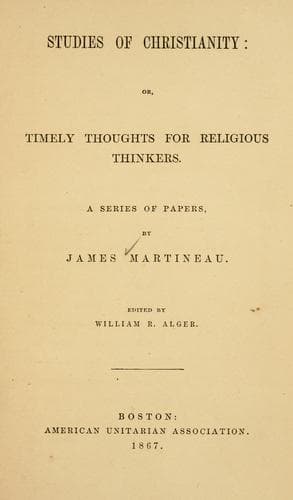
Studies of Christianity; Or, Timely Thoughts for Religious ThinkersMartineau, James
Religion
Studies of Christianity; Or, Timely Thoughts for Religious Thinkers
Martineau, James
Christianity; Church history -- 19th century
9. "The religion is not true because Evangelists and Apostles taught
it; but they taught it because it is true."
10. "Its interior truth must furnish the interpretation of the
writings it has handed down; and no writings handed down can give it
interior truth, if it has none."
In his controversy with Göze, he illustrates this distinction between
the essence and the historical form of Christianity, by a parable to
the following effect. A wise king of a great realm built a palace of
immense size and very peculiar architecture. About this structure,
there came from the very first a foolish strife to be carried on,
especially among reputed connoisseurs, people, that is, who had least
looked into the interior. This strife was not about the palace itself,
but about various old ground-plans of it, and drawings of the same,
very difficult to make out. Once, when the watchmen cried out "Fire,"
these connoisseurs, instead of running to help, snatched up their
plans, and, instead of putting out the fire on the spot, kept standing
with their plans in hand, making a hubbub all the while, and
squabbling about whether this was the spot on fire, and that the place
to put it out. Happily, the safety of the palace did not depend on
these busy wranglers, for it was not on fire at all; the watchmen had
been frightened by the Northern lights, and mistaken them for fire. It
is impossible to convey by a clearer image Lessing's feeling, that a
Christianity once incorporated in the very substance of history and
civilization, seated deep in human sentiment and thought, and
developed into literature, law, and life, subsists independently of
critical questions, and is with us, not as the contingent vapor that a
wind may rise to blow away, but as the cloud that has dropped its rain
and mingled with the roots of things.
In immediate contrast with the foregoing application of a critical
method to the historic documents of Christianity, it is beautiful to
see the same genius turned with eager joy to a practical
recommendation of the experimental life of Christianity.
THE REDEEMING LAW OF SYMPATHY.
Public-domain text, read in full here on John Shaqi.
Reviews
Reviews
No reviews yet
Be the first to share your thoughts on this work.
Join the Discussion
Join the discussion
Sign in to leave a comment or review.
Sign InorCreate an account