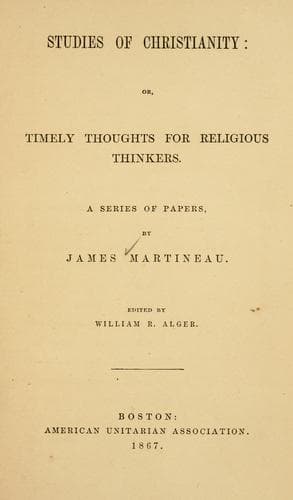
Studies of Christianity; Or, Timely Thoughts for Religious ThinkersMartineau, James
Religion
Studies of Christianity; Or, Timely Thoughts for Religious Thinkers
Martineau, James
Christianity; Church history -- 19th century
displeasure, no contact but of resistance, with our selfishness and sin.
In the simple faith of the conscience it is no figure of speech to say,
that God "is angry with the wicked every day," and is "of purer eyes
than to behold iniquity." So long as the natural religion of the heart
is undisturbed, to sin is, in the plainest and most positive sense, to
set up against Heaven, and frustrate its will.
Soon, however, the understanding disturbs the tranquillity of this
belief, and constructs a rival creed. The primitive conception of God
is acquired, I believe, without reasoning, and emerges from the
affections; it is a transcript of our own emotions,--an investiture of
them with external personality and infinite magnitude. But a secondary
idea of Deity arises in the intellect, from its reasonings about
causation. Curiosity is felt respecting the origin of things; and the
order, beauty, and mechanism of external nature are too conspicuous
not to force upon the observation the conviction of a great Architect
of the universe, from whose designing reason its forces and its laws
mysteriously sprung. Hence the _intellectual_ conception of _God the
Creator_, which comes into inevitable collision with the _moral_
notion of _God the holy watch of virtue_. For if the system of
creation is the production of his Omniscience; if he has constituted
human nature as it is, and placed it in the scene whereon it acts; if
the arrangements by which happiness is allotted, and character is
formed, are the contrivance of his thought and the work of his
hand,--then the sufferings and the guilt of every being were objects
of his original contemplation, and the productions of his own design.
The deed of crime must, in this case, be as much an integral part of
his Providence, as the efforts and sacrifices of virtue; and the
monsters of licentiousness and tyranny, whose images deform the
scenery of history, are no less truly his appointed instruments, than
the martyr and the sage. And though we remain convinced that he does
not make choice of evil in his government for its own sake, but only
for ultimate ends worthy of his perfections, still we can no longer
see how he can truly hate that which he employs for the production of
good. That which is his chosen instrument cannot be sincerely regarded
as his everlasting enemy; and only figuratively can he be said to
repudiate a power which he continually wields. There must be _some
sense_ in which it appears, in the eye of Omniscience, to be eligible;
some point of view at which its horrors vanish; and where the moral
distinctions, which we feel ourselves impelled to venerate, disappear
from the regards of God.
Public-domain text, read in full here on John Shaqi.
Reviews
Reviews
No reviews yet
Be the first to share your thoughts on this work.
Join the Discussion
Join the discussion
Sign in to leave a comment or review.
Sign InorCreate an account